How to Write Your Wedding Vows
Learning how to write wedding vows is one of the most personal parts of planning a wedding. The dress, the flowers, and the first dance all matter, but your vows are the words you will actually remember twenty years from now. They are the promises you make out loud, in front of the people you love most, to the person you love most. That is a lot of pressure for a blank page, which is why so many couples put it off until the week of the wedding. Do not do that. With a simple structure, a few honest stories, and enough time to practice, anyone can write vows that sound like them and mean something real.
If vows are one more item on a long planning list, slot them into your schedule early. Our wedding planning checklist puts vow writing about six weeks before the wedding, which gives you time to draft, revise, and practice without panic.
How Long Should Wedding Vows Be?
Before you write a single sentence, agree on a length with your partner. Most personal wedding vows run between one and two minutes when read aloud, which works out to roughly 150 to 250 words per person. Some couples go a little longer, up to 300 words, but past three minutes the room starts to drift, and your guests stop listening and start checking the time.
Here is the timing math that helps. Most people speak at about 130 words per minute in a ceremony setting, slower than normal conversation because of nerves, pauses, and emotion. So a 150 word vow takes about 70 seconds, a 200 word vow takes about 90 seconds, and a 250 word vow takes about two minutes. That is the sweet spot.
Length also depends on your ceremony style. If your officiant is using traditional vows and you are adding a short personal statement, 100 words may be plenty. If you are writing the entire vow yourselves, 200 to 250 words gives you room for a story, a few promises, and a strong closing line. Check with your officiant too. Some religious ceremonies, especially Catholic weddings, require specific wording and only allow a short personal addition.
The Simple Structure That Works Every Time
Every great vow follows the same three part shape, even if the writer never planned it that way. Think of it as past, present, and promises. Once you have this frame, learning how to write wedding vows becomes a fill in the blanks exercise instead of a staring contest with a blank page.
Part 1: The Past
Open with where you started. This is one short story or memory from the early days of your relationship, told in two or three sentences. Pick a moment only the two of you would remember. A specific moment beats a list of adjectives every time. Nobody remembers “You are kind and wonderful.” Everyone remembers the story about the flat tire on the way to your third date.
Part 2: The Present
Now say who your partner is to you today, not just who they were when you met. What do you love about them right now? What do they do on an ordinary Tuesday that makes your life better? Get specific here too. “You are the first person I want to call with good news, and the only person I can sit in comfortable silence with” says far more than “You are amazing.”
Part 3: The Promises
This is the heart of your vows, and it deserves the most space. Make two or three specific promises, then finish with one big one. The trick is to make your promises concrete enough to keep. “I promise to always be there for you” is vague. “I promise to listen all the way through before I start offering solutions” is a real promise. “I promise to keep making you laugh” is vague. “I promise that when I wake up first, coffee arrives before you do” is a real promise. Mix one light, playful promise in with the serious ones. It keeps the vows honest and keeps the room smiling.
Then close with a single line that lands. Write it last. The best closing lines circle back to the opening, so the vow feels complete. Something like “Today, and every day after, I choose you” is short enough to deliver through tears while looking your partner in the eye.
How to Write Wedding Vows Step by Step
Follow these seven steps in order, and you will have a real draft in about an hour. Do not try to write a perfect first draft. You are collecting material first, then shaping it.
Step 1: Agree on the Ground Rules Together
Sit down with your partner before either of you writes a word. Decide on length, tone, and whether you will keep the vows a surprise. Some couples write independently and never share a word until the ceremony. Others share the structure but not the wording, which keeps the surprise while preventing a tone mismatch.
Step 2: Brainstorm Without Editing
Set a timer for twenty minutes and answer these prompts as messily as you want. Do not worry about sentences yet. Write fragments, single words, half thoughts, whatever comes out.
- When did you know you wanted to marry this person? What was the moment?
- What is a small, everyday thing they do that you love?
- What has this person taught you, or how have you grown because of them?
- What promise do you want to make for the years ahead, not just the wedding day?
When the timer ends, read through your answers and circle anything that made you smile or catch your breath. That is your material. Everything else can go.

Step 3: Pick One Story
Choose the single best memory from your brainstorm. This becomes the opening of your vows. One story told with real detail beats five stories summarized in a rush. If you have two stories you love, save the second one for the reception toast. Your vows are not the place to tell your whole relationship history.
Step 4: Write Your Promises
Write two or three small, specific promises and one big one. Start each with “I promise” so the commitment is unmistakable. Test each promise with a simple question: could I actually do this tomorrow? If the answer is yes, keep it. A promise like “I promise to choose understanding you over winning the argument” is something you can practice every single day. That is what makes it meaningful.
Step 5: Put It in Order
Arrange your material into the past, present, promises frame. Write it the way you talk, not the way you think a wedding vow is supposed to sound. If you never use words like “beloved” or “henceforth” in real life, do not use them in your vows. Your partner should recognize your voice in every line. Read each sentence and ask, “Would I actually say this out loud?” If not, rewrite it in your own words.
Step 6: Read It Out Loud With a Timer
Read your vows out loud, standing up, with a timer running. This is the step most couples skip, and it is the step that matters most. Vows are meant to be spoken, not read silently. You will catch awkward phrases, sentences that run too long, and words that trip you up. Cut anything you stumble over. If you are over your word count, cut the adjectives first and keep the stories and the promises.
Step 7: Copy the Final Version Into a Vow Book
Do not read your vows off your phone at the altar. Buy a vow book, or a nice card, and handwrite or print your final version into it. Give a copy to your officiant or your maid of honor as a backup in case yours goes missing. Aim to have the final copy done at least three days before the wedding, so the last week is for practicing, not writing.

Traditional vs Personal Vows: Which Is Right for You?
Not every couple writes their own vows from scratch, and that is completely fine. Traditional vows have lasted for centuries because they are beautiful, time tested, and easy to deliver under pressure. Personal vows are more intimate and specific to your relationship, but they take more work and more courage. Many couples choose a mix: traditional vows for the legal and ceremonial core, plus a short personal statement of their own. Here is how the two options compare.
| Traditional Vows | Personal Vows | |
|---|---|---|
| Length | Short, usually under 100 words | 150 to 250 words per person |
| Writing time | None, the words are already written | Start 6 to 8 weeks before the wedding |
| Personal touch | Low, the same words every couple says | High, written about your own story |
| Delivery pressure | Low, you repeat after the officiant | Higher, you read or recite your own words |
| Religious rules | Required in many Catholic and Orthodox ceremonies | Often limited to a short addition, if allowed |
| Best for | Couples who want classic wording and zero writing stress | Couples who want their ceremony to sound like them |
| Guest reaction | Respectful and familiar | Often emotional, funny, and memorable |
If you are torn, the hybrid approach is the most popular choice in the United States right now. Say the traditional vows together, then add a short personal vow of your own, around 100 words. You get the weight of tradition and the intimacy of your own words, without the pressure of writing a full two minute speech. Talk to your officiant early, because some churches and venues have firm rules about which words must be included.
3 Complete Wedding Vow Examples
Use these examples as inspiration, not as a script to copy word for word. The best vows borrow a structure and fill it with details only you could write. Each example below follows the past, present, promises frame, so you can see how the structure works in three very different tones.

Example 1: Romantic Wedding Vows
Alex, I still remember the first night we met at that rooftop party in Chicago. You were the only person in the room who asked me what I was reading, and then you actually listened to the answer. I went home that night and told my sister I had met someone different. I did not know then how right I was.
What I love most about you today is how you make ordinary life feel like something worth celebrating. You dance in the kitchen while the pasta boils. You text my mom on her birthday without being asked. With you, I have learned that love is not a grand gesture. It is a thousand small kindnesses, repeated every day.
I promise to protect that softness in you, to be gentle with you on the hard days, and to keep falling for the version of you I have not met yet. I promise to hold your hand through every adventure and every quiet morning, and to choose you, again and again, for as long as I live. Today, and every day after, I choose you.
Example 2: Funny Wedding Vows
Jordan, when we met, you told me you were low maintenance. I have since met your skincare routine, your fantasy football league, and your collection of hot sauces, so I would like to revise that statement for the record. But I fell in love with you anyway, somewhere between the third date and the night you drove forty minutes in the rain to bring me soup when I was sick.
You are the only person I would let pick the restaurant every single time, and the only person who can make me laugh when I am determined to stay annoyed. You steal the covers, you quote movies at the worst possible moments, and you somehow always know when I need a hug before I do.
I promise to love you even when you steal the covers, to pretend your fantasy team has a real chance this year, and to never, ever watch the next episode of our show without you. I promise to keep a granola bar in my bag for when you get hungry and turn into someone else. And under all of that, I promise to be the person you can laugh with when everything else goes sideways. You are my favorite person, my best friend, and my favorite argument. I love you.
Example 3: Short Wedding Vows
Sam, before you, I thought home was a place. Then you showed up, and home became a person. You are my calm on the hard days and my loudest cheer on the good ones.
I promise to love you loudly in public and patiently in private. I promise to say the kind thing out loud instead of assuming you already know it. I promise to grow with you, to laugh with you, and to hold your hand until our hands look like our grandparents’ hands. I choose you today, and I will choose you every day after.
If short vows appeal to you, keep the whole thing under 120 words. A short vow works best when every sentence earns its place, so cut anything that is only there to fill space. Your guests will remember a short, honest vow far longer than a long, forgettable one.
Writing Prompts to Get You Started
If you are still stuck while learning how to write wedding vows, these prompts will pull out the material you need. Answer them quickly, without overthinking. The honest answers are usually the first ones.
- What was your first impression of them, honestly?
- When did you know this was different from every relationship before it?
- What is a small moment from the early days that nobody else knows about?
- What do they do that makes an ordinary day better?
- When have you been proudest of them?
- What is something they do that they do not think anyone notices?
- What does an ordinary Tuesday look like in ten years?
- What do you want your home to feel like?
- What are you looking forward to doing together that you have never done?
- What part of your life together do you never want to change?
Pick the answers that feel the most alive, then build your vows around them. You only need one good story, two or three honest observations, and a handful of real promises. That is the whole recipe.
How to Practice and Deliver Your Vows
Writing your vows is only half the job. Delivering them is the other half, and a little practice makes an enormous difference. Start practicing about a week before the wedding, reading your vows out loud every day. Practice standing up, the way you will at the ceremony, and practice looking up from the page. Your partner is the audience, not the paper.

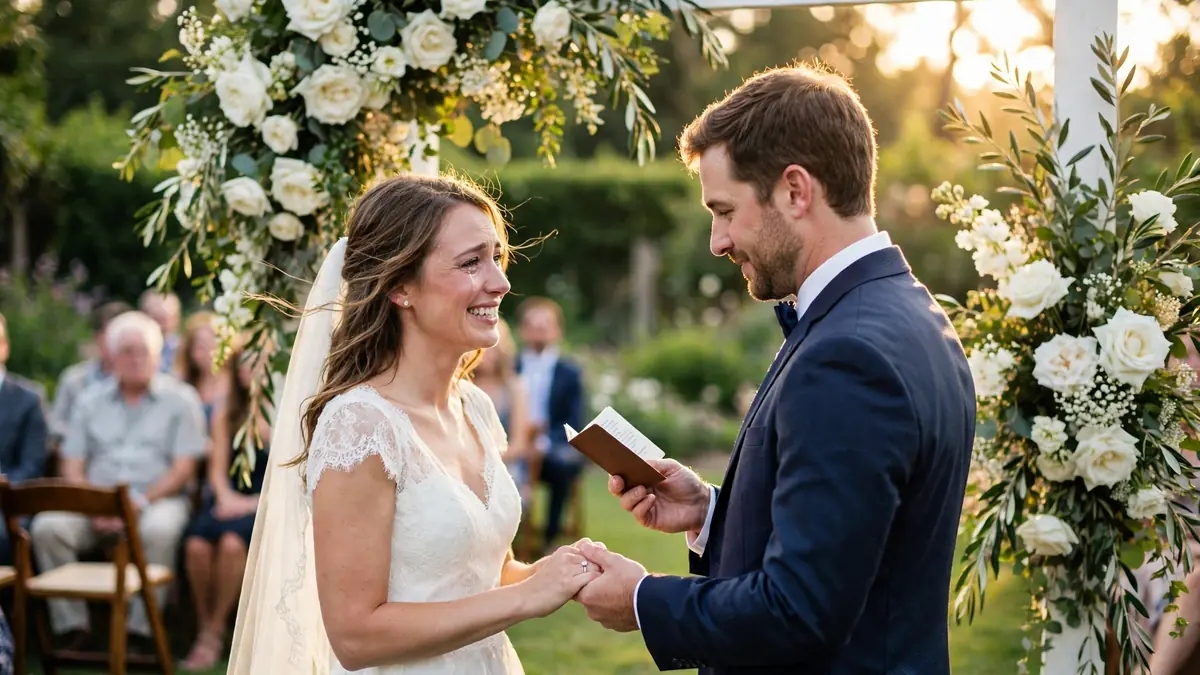
What if you cry? You probably will, and that is completely fine. Your guests expect tears at a wedding. If you feel them coming, pause, take a breath, and keep going. Nobody will judge you for crying during your own vows. If you are worried about losing your place, have your officiant hold a backup copy, and ask a friend to stand nearby with tissues and water.
One practical detail many couples forget: coordinate the vows with the rest of the ceremony timeline. Your vows sit between the readings and the ring exchange in most American ceremonies, so check the order with your officiant and your planner. Our wedding day timeline shows exactly where vows fit in a typical ceremony, which helps you plan the pacing of the whole event. And if you are still choosing music for the moments around your vows, our first dance songs guide can help you pick the right songs for the reception that follows.
Mistakes to Avoid When You Write Your Wedding Vows
Most mistakes couples make when learning how to write wedding vows are easy to avoid once you know what they are. Here are the ones that come up again and again.

- Starting too late. Begin at least six weeks before the wedding. Vows written the night before sound like vows written the night before.
- Writing too long. Past three minutes, the room drifts. Cut ruthlessly and keep the stories and the promises.
- Being too vague. “You are the best” could describe anyone. “You are the person who brings me coffee in bed on Sundays” could only describe your partner.
- Making promises you cannot keep. “I promise to never make you sad” is impossible. “I promise to listen before I argue” is something you can actually do.
- Including inside jokes nobody understands. One private joke is charming. Five in a row leaves your guests confused and your partner embarrassed.
- Mentioning exes or past relationships. Your wedding day is not the time for that history, no matter how funny the story seems.
- Using humor that embarrasses your partner. Tease gently, never at their expense. If a joke would hurt in front of a hundred people, leave it out.
- Forgetting to check the rules. Some religious ceremonies require specific wording. Confirm with your officiant before you write a word.
Frequently Asked Questions About Writing Wedding Vows
How long should wedding vows be?
Most personal wedding vows run 150 to 250 words, which takes about one to two minutes to read aloud. Short vows can be under 120 words, and longer vows can reach 300 words, but anything past three minutes loses the room. Agree on a word count with your partner so your vows feel balanced.
When should I start writing my wedding vows?
Start six to eight weeks before the wedding. That gives you time for a messy first draft, a few rounds of editing, and a week of practicing out loud. Have the final version copied into your vow book at least three days before the wedding so the last week is for practice, not writing.
Do we have to write our own vows, or can we use traditional vows?
You do not have to write your own vows at all. Traditional vows are a beautiful, time tested choice, and many couples repeat them after the officiant. The most popular option in the United States is a hybrid: traditional vows for the ceremonial core, plus a short personal statement of 100 words or so.
Should we share our vows with each other before the wedding?
That is entirely up to you. Keeping them a surprise makes the ceremony more emotional, but it risks a tone mismatch if one person writes something funny and the other writes something deeply serious. A good middle path is to share the structure and the word count, but not the actual words. If one of you is nervous about the surprise, sharing the drafts is always the safer choice.
What if I cry while reading my vows?
Crying during your vows is normal, expected, and honestly charming. Pause, take a breath, and keep going when you are ready. Mark a pause in your vow book before the closing line so you have a natural place to collect yourself. Have your officiant hold a backup copy and a friend nearby with tissues, just in case.
Learning how to write wedding vows is really about learning how to say what you already feel. You do not need perfect poetry or a professional speechwriter. You need one honest story, a few specific things you love about your partner, and promises you can actually keep. Start early, write it the way you talk, practice it out loud, and trust that your own words will mean more to your partner than anything you could copy from a template.