
Rehearsal Dinner Etiquette: Who Hosts, Who Is Invited

Rehearsal dinner etiquette can feel confusing, especially when two families, a wedding party, and a long list of traditions all meet at one table the night before the wedding. The good news is that the rules are simpler than they look. This guide explains rehearsal dinner etiquette from start to finish: who hosts, who pays, who is invited, what it costs, how toasts work, what to wear, and the mistakes to avoid.
A rehearsal dinner is the meal that follows the wedding ceremony rehearsal, usually held the evening before the wedding. It is a thank you to the people who are giving their time and energy to the wedding, and the first time both families and the whole wedding party sit down together. The dinner usually lasts two to three hours, and the mood is intentionally more relaxed than the wedding reception.
What Is a Rehearsal Dinner?
The rehearsal dinner follows the ceremony rehearsal, the practice run where the wedding party walks through the ceremony order and where everyone stands. The rehearsal takes about 30 to 45 minutes, and the dinner starts right after. Most couples hold it the night before the wedding.
The dinner is not just a meal. It is the moment when the wedding party meets each other properly and the couple can thank everyone in person. If you are still building the big picture, our wedding planning checklist covers where the rehearsal dinner fits into the full timeline.
Who Hosts the Rehearsal Dinner?
By tradition, the groom’s parents host the rehearsal dinner. The custom comes from an old division of wedding costs: the bride’s family traditionally paid for the wedding, and the groom’s family hosted the dinner the night before.
Today the hosts can be the groom’s parents, the bride’s parents, both sets of parents together, another relative, or the couple themselves. The key point is that the host is the person or family who organizes and pays, and the host gets a real say in the guest list, the venue, and the menu.
When two families share hosting, agree on the split early and put it in writing. Decide who books the venue, who sends the invitations, and who handles the bill.
Divorced or blended families need a little extra care. If both of the groom’s parents want to host, they can split the cost and host together, sitting separately and giving separate toasts. If they cannot work together comfortably, one parent can host the rehearsal dinner while the other hosts a different event, such as the welcome brunch. Nobody should be forced to co-host with an ex-spouse.
For same-sex couples, the old tradition does not apply, so the couple simply chooses who hosts. For second weddings, the couple almost always hosts. In every case, the right host is the person who wants to host and can afford it.
Who Pays for the Rehearsal Dinner?
Whoever hosts the rehearsal dinner pays for it. When the groom’s parents host, they pay. When the couple hosts, they pay. When both families split hosting, they split the bill in whatever proportion they agreed on, often 50/50.
The hosts pay for everyone at the table. It is not appropriate to ask guests to pay for their own meal, because the wedding party is required to attend the rehearsal. This applies to food, drinks, tax, and tip.
Money and control go together. Whoever contributes financially gets a say in the decisions. If the couple wants full control, they should pay for the dinner themselves. Discuss the budget before any venue is booked, not after.
What the hosts pay for usually includes the venue or private room fee, food and drinks, tax and gratuity, invitations, and simple centerpieces. Travel and hotel costs for guests are not the host’s responsibility.
How Much Does a Rehearsal Dinner Cost?
According to The Knot 2026 Real Weddings Study of 10,474 couples married in the United States in 2025, the average rehearsal dinner costs $2,800. Most couples spend between $1,350 and $4,500 in total, and the per-person cost at a restaurant usually runs $55 to $150.
The final bill depends on how many people are invited, where the dinner is held, and how formal the food and drink are. A backyard barbecue for 20 people can cost under $1,000, while a private room at an upscale restaurant in New York City for 50 people can easily pass $7,000.

| Dinner style | Typical per-person cost | Total for 30 guests |
|---|---|---|
| Backyard barbecue or home-cooked meal | $25 to $40 | $750 to $1,200 |
| Casual restaurant, private room | $30 to $75 | $900 to $2,250 |
| Mid-range restaurant, plated dinner | $55 to $100 | $1,650 to $3,000 |
| Upscale restaurant or venue buyout | $100 to $150 | $3,000 to $4,500 |
| Premium venue, full bar and courses | $150 and up | $4,500 and up |
Keep the budget in check with a few simple choices. Limit the bar to beer, wine, and one signature cocktail. Choose a family-style or buffet menu instead of a plated multi-course dinner. And remember that the guest list is the biggest cost lever: every extra table adds hundreds of dollars.
Who Is Invited to the Rehearsal Dinner?
Think of the guest list in three groups: the people who must be invited, the people who are often invited, and the people who are not invited.

Always invited: the couple, the wedding party (bridesmaids, groomsmen, maid of honor, best man, and any junior attendants), the partners or spouses of everyone in the wedding party, both sets of parents and stepparents, siblings of the couple, the officiant and their partner, and anyone else with a role in the ceremony, such as readers, musicians, ushers, the flower girl, and the ring bearer. The parents of child attendants are also invited.
Often invited: grandparents, close family who have traveled far, and out-of-town guests. Inviting all out-of-town guests is a generous and common gesture. At a destination wedding, though, this can mean inviting almost the whole guest list, so many destination couples limit the dinner to the wedding party and immediate family.
Not invited: wedding guests who have no role in the ceremony and did not travel from out of town. It is not rude to leave them out. The rehearsal dinner is a working dinner for the people involved in the wedding, not a second reception. What is rude is inviting someone to the dinner who is not invited to the wedding. Every rehearsal dinner guest must also be on the wedding guest list.
Plus-ones deserve a clear rule. The partners and spouses of the wedding party are always invited, even if the wedding itself has a no-plus-one policy. Whatever rule you choose for other guests, apply it evenly.
Kids are welcome when they are part of the wedding party, and their parents come too. For other children, follow the same rule as the wedding itself, and say so clearly on the invitation so parents can plan childcare.
Rehearsal Dinner Invitations: When to Send and What to Include
Rehearsal dinner invitations do not need to be as formal as wedding invitations. For a small, casual dinner, a phone call, text, or email is fine. For a larger or more formal dinner, send printed or digital invitations from the host, separately from the wedding invitation.
Send invitations three to four weeks before the rehearsal dinner. Include the date, time, venue name and address, dress code, and how to reply. If the rehearsal itself is at a different location or time, put those details on a separate schedule for the wedding party, not on the dinner invitation.
The invitation should come from the host and name the host. Digital invitations from services like Paperless Post or Evite are widely accepted now, and they make RSVP tracking much easier.
The host needs a firm headcount to confirm the restaurant reservation and the food order, so set an RSVP deadline about one week before the dinner and follow up personally with anyone who has not replied.
When and Where Should the Rehearsal Dinner Happen?
Rehearsal dinner etiquette says the dinner almost always happens the night before the wedding, right after the ceremony rehearsal. The rehearsal usually starts around 5 or 6 p.m. and lasts 30 to 45 minutes, and dinner follows at about 6:30 or 7 p.m. Plan for the dinner to end by 9 or 9:30 p.m. at the latest.
If the wedding is on a Saturday, the rehearsal and dinner are usually on Friday evening. Some couples with a very early wedding or a complicated ceremony move the rehearsal to two nights before, which gives everyone a free evening before the wedding day.
Choose a venue close to the ceremony site or to where most guests are staying, ideally within 30 minutes of driving. A private dining room at a restaurant is the classic choice for groups of 15 to 50. Other good options include a family home, a backyard, or a local brewery. Avoid the wedding venue itself, because it can upstage the next day.
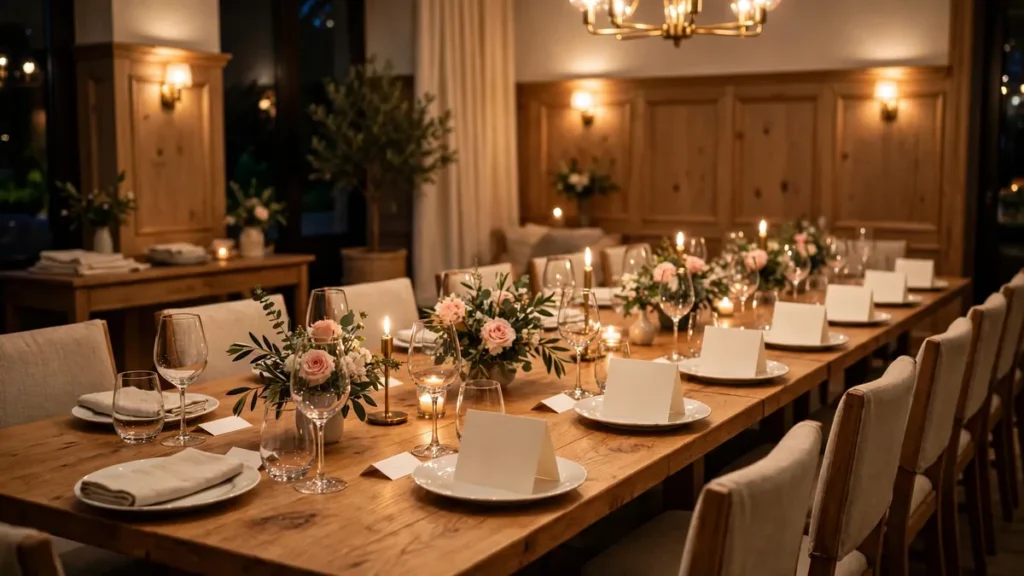
Think about the tone you want. If the wedding is formal, a relaxed dinner with a different style of food gives guests a welcome change of pace. Many couples pick a theme tied to the location, such as a Texas barbecue in Austin or a clambake in New England.
Book the venue early. Popular private dining rooms in US cities are often reserved three to six months ahead. When you book, confirm the minimum spend, the room capacity, the menu options, and whether a microphone is available for toasts.
What to Wear to a Rehearsal Dinner
The rehearsal dinner is usually one step more casual than the wedding. If the wedding is black tie, the rehearsal dinner is cocktail attire. If the wedding is semi-formal, the rehearsal dinner is dressy casual. If the wedding is a casual backyard celebration, the dinner can be as relaxed as sundresses and linen shirts.
For the couple, the rehearsal dinner is a chance to wear something fun and different from the wedding outfit. Many brides choose a white or ivory cocktail dress or a jumpsuit, and many grooms wear a blazer with no tie or a suit in a lighter fabric.

The invitation should state the dress code clearly. Common dress codes and what they mean:
| Dress code on the invitation | What it means | Good choices |
|---|---|---|
| Casual | Relaxed and comfortable | Sundresses, linen shirts, nice jeans with a blazer |
| Dressy casual | Polished but not formal | Cocktail dresses, jumpsuits, chinos with a sport coat |
| Cocktail attire | Party ready, no gowns | Knee-length dresses, dark suits, dressy separates |
| Semi-formal | Close to wedding level | Longer dresses, suits and ties |
| Theme or location specific | Match the setting | Follow the invitation note, such as boots for a barn |
A few practical rules help everyone. Do not wear white unless you are the bride. If the dinner is outdoors, bring a layer for the evening. And if you are unsure, dress one step up rather than one step down.
The wedding party usually rehearses in everyday clothes and changes before dinner, so tell them in advance to bring a change of clothes.
Toasts and Speeches: The Right Order
The rehearsal dinner is the best place for the long, personal toasts that do not fit into the wedding reception. Toasts here are less formal than reception speeches, and they are not mandatory, but it is customary for the host to welcome the guests and toast the couple.

Plan the toasts in advance. A set order keeps the evening from turning into an open mic night. A good order looks like this:
1. The host speaks first. Traditionally the groom’s father, or whoever is hosting, welcomes everyone and toasts the couple. Keep it to two or three minutes.
2. The other parents speak next. The bride’s parents, or the other set of parents, follow with a short welcome and a few words about the couple.
3. The wedding party and close friends speak. This is the right place for a friend who is not giving a speech at the reception, so other voices get a chance to shine.
4. The couple closes. The couple thanks their families, the wedding party, and everyone who traveled. This is also the moment to present gifts to the wedding party and parents.
Keep every toast to three to five minutes, so the whole toast portion lasts no more than 20 to 30 minutes. Ask speakers to avoid inside jokes, stories about exes, and anything embarrassing.
A simple wireless microphone and a small speaker make a big difference in a restaurant private room. Ask the venue if they provide one, or bring your own.
Gifts at the Rehearsal Dinner
The rehearsal dinner is the traditional moment for the couple to give gifts to the wedding party and to their parents. Gifts do not need to be expensive. Personal, useful gifts are remembered far longer than pricey ones.

Popular choices include personalized items such as engraved flasks or monogrammed tote bags, practical gifts such as a nice bottle of bourbon or a spa set, and experience gifts such as a dinner out. For parents, a framed photo or a handwritten letter is often the most meaningful gift of all. If the groom needs ideas for his side, our groom wedding checklist includes gift ideas for groomsmen and parents.
Guests do not need to bring their wedding gifts to the rehearsal dinner. Bring your gift to the wedding itself, or send it to the couple’s home before or after the wedding.
Small favors for guests are optional but thoughtful. A local treat, a small candle, or a handwritten note at each place setting all work well. Keep favors under $5 to $10 per guest.
Rehearsal Dinner vs. Welcome Party: What Is the Difference?
Many couples now host both a rehearsal dinner and a welcome party, and the two are easy to confuse. The rehearsal dinner is a seated meal for the wedding party, immediate family, and the officiant, held right after the ceremony rehearsal. The welcome party is a casual drinks-and-snacks gathering for all out-of-town guests.
The welcome party is the solution when the couple wants to greet every out-of-town guest without inviting 80 people to the rehearsal dinner. A common schedule is a welcome party from 5 to 7 p.m., followed by a private rehearsal dinner at 7:30 p.m.
If the budget only allows one event, choose the rehearsal dinner. A welcome party is a lovely extra, but it is never required.
Common Rehearsal Dinner Etiquette Mistakes to Avoid
Most rehearsal dinner problems come from small, avoidable mistakes. Here are the ones that cause the most trouble.
Inviting people to the dinner who are not invited to the wedding. Check the wedding guest list before you finalize the dinner list.
Letting the dinner run too late. A rehearsal dinner that ends at midnight leaves a tired, possibly hungover wedding party for the next morning. End by 9:30 p.m., and keep the bar modest.
Turning it into a second reception. A full band, a dance floor, and a multi-course tasting menu belong at the wedding, not the night before.
Forgetting the officiant. The officiant is part of the ceremony and should be invited to the dinner with their partner.
Skipping the thank yous. A short, sincere thank you from the couple at the end of the toasts costs nothing and means everything.
Letting one family take over. When the host family plans everything without input from the other family, resentment builds. Share the plan, ask for opinions, and make the couple the final decision makers.
Rehearsal Dinner Planning Timeline
Here is a simple timeline that keeps everything on track.
| When | What to do |
|---|---|
| 6 to 4 months before | Decide who hosts and who pays, set the budget, and agree on the guest list |
| 4 to 3 months before | Book the venue, confirm the menu and bar, and check the minimum spend |
| 3 to 4 weeks before | Send rehearsal dinner invitations with the dress code and RSVP details |
| 2 weeks before | Confirm the final headcount with the venue and plan the toast order |
| 1 week before | Follow up on missing RSVPs, buy wedding party gifts, and confirm the rehearsal time |
| Day of the dinner | Arrive early, check the room setup, enjoy the evening, and end by 9:30 p.m. |
If you are hosting an engagement party as well as a rehearsal dinner, keep the two events distinct in style and guest list. Our engagement party planning guide covers the earlier celebration in the same level of detail.
Frequently Asked Questions About Rehearsal Dinner Etiquette
Do you have to have a rehearsal dinner? No. A rehearsal dinner is optional, though it is expected in many parts of the United States, especially in the South and Midwest. If the ceremony is simple, a casual meal with the wedding party can replace a formal dinner.
Who pays for the rehearsal dinner if the couple is paying for the wedding? The couple can pay for the rehearsal dinner too, and many do. Paying for it themselves also gives them full control over the guest list, the venue, and the menu.
Do out-of-town guests have to be invited? No, but it is a kind and common gesture. Many couples invite all out-of-town guests to the rehearsal dinner or to a separate welcome party. At a destination wedding, it is fine to limit the dinner to the wedding party and immediate family.
What if divorced parents both want to host? They can co-host and split the cost, sitting separately and giving separate toasts. If that will not work, one parent hosts the rehearsal dinner and the other hosts another event, such as the welcome brunch.
Rehearsal dinner etiquette comes down to a few simple ideas: thank the people who are giving their time to the wedding, pay for the meal you invite them to, keep the evening relaxed and shorter than the reception, and make sure everyone knows when, where, and what to wear.