
Mehndi Ceremony: US Planning Guide, Costs & Timeline

The mehndi is the most joyful night of a desi wedding week: music, dancing, henna, and the people you love best, all in one room. But planning one in the United States comes with questions no generic guide answers well. How far ahead do you book a henna artist? How many artists do you need for 60 guests? Is a mehndi different from a dholki or a sangeet, and do you need all three? This guide answers all of it, with real US costs, a booking playbook, decor sourcing, food math, and a day-of checklist.
The mehndi (also spelled mehendi) is traditionally the henna night: the bride’s hands and feet are adorned with intricate designs while family and friends sing, dance, and celebrate around her. In the US, it has grown into a full event of its own, often the largest pre-wedding party, with decor, catering, a DJ or live dhol player, and guest counts that rival the wedding itself. Planning it well means understanding what the evening actually looks like, then working backward from there.
What Is a Mehndi Ceremony?
At its heart, the mehndi ceremony is a blessing wrapped in a party. A paste made from the dried leaves of the henna plant is piped onto the bride’s hands and feet in elaborate patterns, left to dry, then flaked away to reveal a rich reddish-brown stain that deepens over 48 hours and lasts one to three weeks.

The symbolism runs deep. Mehndi represents love, prosperity, and good fortune for the marriage. A beloved folk belief holds that the darker the bride’s stain, the deeper her partner’s love, which turns the waiting period after application into a playful family ritual. Many brides have the groom’s name or initials hidden inside the design, and finding it becomes a lighthearted wedding-night game.
The ceremony is celebrated across Hindu, Muslim, and Sikh weddings, with distinct regional flavors. Punjabi families bring high-energy bhangra to the night, Pakistani and Muslim families often hold it as a women’s gathering sometimes called the mayoun, Gujarati families blend it with raas-garba dancing, and Bengali families weave in their own pre-wedding customs. In the US, where relatives fly in from different cities, the mehndi has become the warm-up party of the wedding week: less formal than the ceremony, more intimate than the reception, and usually the event guests remember most fondly. If your celebrations also include the Islamic marriage contract, our nikkah ceremony guide covers that ritual in the same practical detail.
What Actually Happens at a Mehndi: The Evening, Hour by Hour
A typical US mehndi runs four to six hours: guests arrive to music and appetizers while the bride takes her seat at the decorated stage; the bride’s henna begins early (it takes two to four hours) while family dances and toasts fill the middle of the night; dinner lands around hour four; then the floor opens for dancing, often with a live dhol set, before group photos close the evening. Every planning decision, artist count, food timing, music schedule, hangs off this flow.
When Should You Hold the Mehndi?
Timing matters more than most couples realize, because the stain needs time to peak. Hold the mehndi two to three days before the wedding: henna reaches its darkest shade roughly 48 hours after application, so a Thursday mehndi gives you a rich, deep stain for a Saturday wedding.
Afternoon into evening is the classic slot. Bridal application alone takes three to five hours for full hands and feet, so start the bride early (around noon or 1 PM) and let her finish as guests arrive in the late afternoon. The party then flows naturally into dinner, music, and dancing.
Many US families combine events to save on venue and vendor costs. Popular combinations include mehndi plus sangeet in one evening (henna in the afternoon, performances after sunset) or haldi in the morning with mehndi in the afternoon. If you combine, protect the bride’s drying henna: schedule her application first and keep the dance performances gentle until the paste is sealed.
Mehndi vs Dholki vs Sangeet: Which Events Do You Actually Need?
US couples confuse these three constantly, and no wonder: the names travel across regions with different meanings. Here are the working definitions:
- Mehndi: the henna night, centered on the bride’s henna application, with music and dancing. Traditionally the bride’s family’s event.
- Dholki: an intimate singing night, historically women gathered around a dholki (hand drum) singing traditional wedding songs. Smaller, homier, often at someone’s house.
- Sangeet: the music-and-dance night, with choreographed performances by both families, often the most produced pre-wedding event. Traditionally the groom’s family’s event, now usually joint.
Do you need all three? Almost certainly not. Most US couples pick one or two. The common patterns: a combined mehndi and sangeet (one big night, performances plus henna), which is the most popular choice; a separate intimate dholki at home plus a big sangeet; or a single mehndi that absorbs everything. The deciding factors are budget, venue availability, and how many nights your families can sustain. Three full production nights exhaust everyone, including you.
Your Planning Timeline
3 to 6 months out: book the henna artist (top US artists book out through peak season), lock the venue, set the guest count range, and decide the structure: standalone mehndi, combined mehndi-sangeet, or multiple nights.
2 to 3 months out: book caterer, DJ or musicians, decorator, and photographer. Order decor with long lead times. Send invitations with the dress code.
1 month out: finalize headcount, confirm vendors in writing, plan performance lineups, do a henna trial, buy the bride’s outfit.
Week of: confirm vendor arrival times, prep henna station supplies, check the rain plan. Manicure and pedicure two to three days before (not the day before). Avoid waxing, tanning, or swimming in the 48 hours before henna; all three interfere with the stain.
Booking a Henna Artist in the US: The Playbook
This is the section no competitor covers properly, and it is the highest-stakes booking of the whole event. A great henna artist makes the night; a bad one ruins the bride’s most photographed detail.
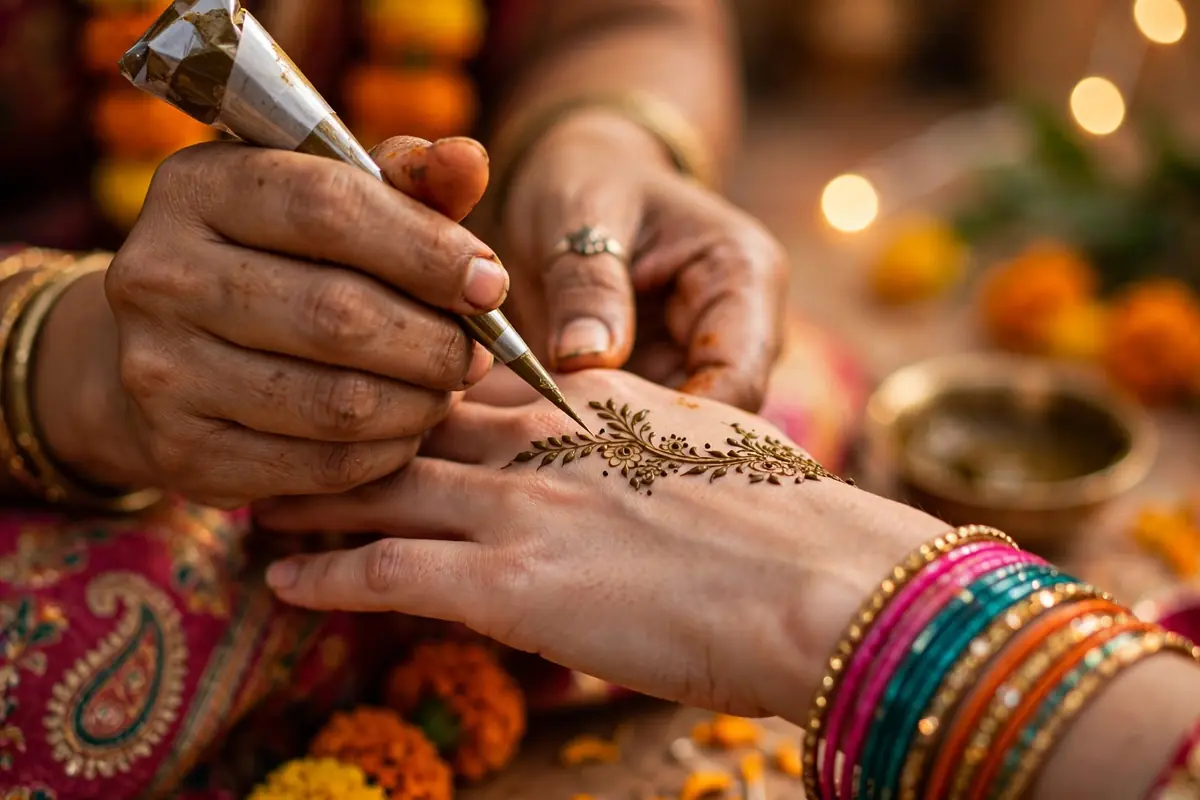
How far ahead
Three to six months for peak season, two to three months minimum otherwise. The best artists in major metros (New York, Chicago, Houston, the Bay Area, Dallas) are booked solid through wedding season. If your date is fixed, book the artist before you book the decorator.
Costs
Bridal henna in the US typically runs $250 to $800+ depending on the city, the artist’s reputation, and how elaborate the design is (hands only versus hands plus feet, full coverage versus minimal). Guest henna is usually priced per hour ($75 to $150/hour) or per design, with simple motifs at $10 to $25 per guest. A bridal trial, highly recommended, runs $50 to $150 and is often credited toward the booking.
How to vet
Ask for a portfolio of healed henna photos, not just fresh application shots; the stain’s final color is what matters. Ask whether they use organic homemade cones or pre-made cones, and what is in the paste. Red flags: artists who cannot show healed work, who use “black henna” (which often contains paraphenylenediamine, a chemical that causes burns and allergic reactions), who will not do a patch test, or who quote a bridal price without asking about design complexity. A professional asks about your outfit colors, your wedding date (so the stain peaks correctly), and any skin sensitivities.
The trial
Book a trial four to six weeks out. You are testing three things: the design style, the paste quality (stain should develop rich reddish-brown within 24 to 48 hours), and your skin’s reaction. Bring your outfit or a fabric swatch so the artist can coordinate the design density.
Mehndi Design Styles for the Bride
The design style sets the visual tone of your bridal henna. Four styles dominate, and many US brides now choose a fusion of two.
Traditional Indian: dense, intricate patterns covering the full hand and often the forearm. Paisleys, peacocks, mandalas, and fine line work with heavy fill and minimal negative space. The classic bridal look, and the longest application time.
Arabic: bold, sweeping florals with open spaces, large flowers and vines with thick outlines. Faster to apply and strikingly modern in photos.
Indo-Arabic fusion: Indian intricacy softened with Arabic boldness, mixing fine detail and open space. The most requested style among US brides because it photographs well and does not require the longest sitting time.
Minimalist: fingertip designs, single palm motifs, or geometric shapes with maximum negative space. Perfect for brides who want understated elegance or who are short on time.
Motifs carry meaning worth knowing. Paisleys signify fertility and abundance. Peacocks represent beauty and grace, especially in Rajasthani designs. The lotus stands for purity and new beginnings. Mandalas, often placed at the center of the palm, symbolize unity and eternity. Vines and leaves speak to growth and the journey of partnership.
Modern brides increasingly personalize the design: the couple’s initials, the wedding date, a miniature portrait, or symbols from their love story (a skyline of the city where they met, a shared hobby, a favorite place). Share these ideas at your trial, not on the day, so the artist can sketch the custom elements in advance. Also coordinate the design density with your outfit: heavily embroidered sleeves pair better with slightly simpler henna, while a plainer outfit lets full intricate coverage shine.
Day-of Henna Logistics for 50+ Guests
Artist-to-guest ratio: one artist does roughly 8 to 12 simple designs per hour. For 50 guests over three hours, bring two artists minimum, three for comfort. Keep the bridal artist separate; her work takes hours and cannot be interrupted.
Station setup: each artist needs a small table, two chairs, good lighting, and a trash bin, placed near the action but out of the food-traffic path. Post a sign with three to four simple motif options at set sizes; open-ended requests stall the line.
Queue management: assign a family member to run the list. Workable priority: elderly guests first, then the wedding party, then everyone else. Cap designs at one hand per guest once the line passes 15 people, and announce last call 45 minutes before close.
Venue: Backyard vs Hall vs Restaurant
| Backyard | Banquet hall | Restaurant buyout | |
|---|---|---|---|
| Typical cost | $0 to $2,000 (tent/rentals) | $1,500 to $5,000 | $1,000 to $3,000 food minimum |
| Capacity | Flexible, weather-dependent | 100+, climate controlled | 40 to 80 |
| Vibe | Intimate, personal | Polished, spacious | Effortless, food-forward |
| Biggest risk | Weather | Feels impersonal if half-empty | Space constraints for dancing |
| Best for | Under 80 guests, summer dates | 100+ guests, any season | Smaller, foodie crowds |
The backyard mehndi is the romantic favorite and the logistical gamble. If you go this route, price the tent before you fall in love with the idea: a 20×40 tent with sidewalls runs $800 to $2,000 in most US markets, and you need it reserved, not just quoted. Halls are the safe choice for large guest counts and unpredictable seasons. Restaurant buyouts work beautifully for smaller mehndis where the food is the point.
Decor That Looks Expensive
Mehndi decor has a signature palette: marigolds, jewel tones, brass, and fairy lights. The good news is that this look is cheap to achieve because the elements are inherently festive.
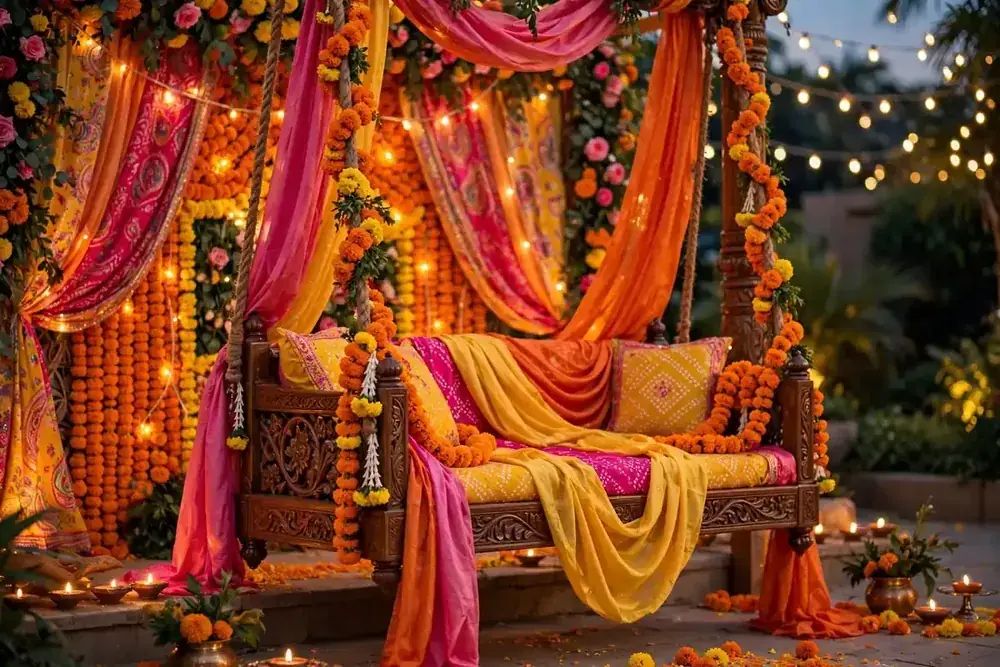
The stage: a low seating area or decorated swing (jhula) with vibrant drapes behind it is the classic focal point. Fabric drapes ($30 to $80 in bulk from online sellers) transform any wall. Marigold garlands, fresh or faux, run $15 to $40 per strand.
Where to source in the US: Etsy for handmade and customized pieces; local desi event-rental companies for stages, drapes, and brass accents (search “[your city] Indian wedding decor rental”); Amazon for fairy lights and bulk marigolds; and the family-trip trick, relatives visiting India or Pakistan bring back textiles, bangles for table scatter, and embroidered runners at a fraction of US prices. Start sourcing two months out; shipping from overseas sellers takes weeks.
The rule: pick two hero elements (the stage and the entrance, say) and keep everything else simple. Ten mediocre decorations look cheaper than three excellent ones. For table-level details that stretch a decor budget, our DIY wedding centerpieces guide has ideas that work beautifully for mehndi tables too.
Food: Chaat Stations vs Full Dinner
This is the budget decision that shapes the whole evening. The per-head math:

- Chaat and appetizer stations: $12 to $25 per head. Samosa chaat, pani puri, bhel puri, kebab skewers. Interactive, festive, and perfect for a mehndi’s grazing energy.
- Full dinner buffet: $25 to $60+ per head depending on the caterer and menu. Necessary if the event runs through a mealtime with 100+ guests.
- Hybrid (most popular): heavy appetizers and chaat stations early, then a smaller dinner spread. $20 to $40 per head.
The decision framework: if your mehndi starts at 6 p.m. and runs past 9, you are serving dinner whether you call it that or not, so budget accordingly. Chaat stations double as entertainment; guests love watching pani puri made to order. For 80 guests, the gap between chaat-only and full dinner is roughly $1,000 to $2,500, which is real money. When in doubt, go hybrid: nobody remembers whether there was a formal dinner, but everyone remembers great chaat.
Music and Entertainment
The dholki tradition: at its simplest, aunties with a dholki drum singing folk songs. If your family carries this tradition, protect a 30-minute slot early in the evening; it is the most emotionally resonant part of the night for the older generation.
Live dhol player ($300 to $800): a 1 to 2-hour high-energy set transforms the dancing. Book 2 to 3 months out.

DJ ($500 to $1,500): brief yours that this is not a reception set. You want bhangra, Bollywood, and family-friendly dance music with room for family performance slots. Share the run-of-show in advance and collect performance tracks a week ahead.
Outfits: Bride, Family, and What to Tell Guests
The bride: yellow, green, orange, or pink dominate mehndi tradition, but the real rule is contrast with your henna: the deeper the outfit color, the more the henna-stained hands pop in photos. Shararas, lehengas, and anarkalis are all classic. Budget $200 to $1,500+; many brides rewear or borrow. One practical warning: avoid white or very light fabrics. Wet henna paste stains permanently, and the bride’s sleeves and dupatta will touch it. Floral jewelry (fresh flowers strung on wire) is the signature mehndi accessory; save the real gold for the wedding day. Flat juttis or embroidered slides beat heels for a function spent mostly seated.

The groom: a printed kurta with a Nehru jacket, a colorful bandhgala, or a relaxed kurta-pajama in mustard, teal, or coral. Matching the bride’s color palette (not her exact outfit) creates a cohesive look in photos.
Where to shop in the US: the big desi shopping streets are Oak Tree Road in Edison, New Jersey; Pioneer Boulevard in Artesia, California; Devon Avenue in Chicago; and Hillcroft in Houston. Online, Pernia’s Pop-Up Shop, Aza Fashions, and Utsav Fashion all ship to the US with delivery in two to four weeks, so order at least six weeks out to allow for alterations. For one-wear outfits, check rental services and local desi consignment groups on Facebook.
Family: coordinate, do not match. Pick a palette (jewel tones, say) and let everyone interpret it. This photographs far better than identical outfits.
Guest dress code wording: put it on the invitation, plainly: “Dress code: festive traditional or cocktail attire in bright colors. Please avoid white and black.” Guests are relieved to be told; vague dress codes produce anxious guests.
Realistic Budget Breakdown
| Line item | Typical US range |
|---|---|
| Bridal henna | $250 to $800 |
| Guest henna artists (2) | $300 to $900 |
| Venue | $0 to $5,000 |
| Decor and rentals | $500 to $3,000 |
| Food (80 guests, hybrid) | $1,600 to $3,200 |
| DJ | $500 to $1,500 |
| Live dhol player | $300 to $800 |
| Photographer | $500 to $2,000 |
| Bride’s outfit | $200 to $1,500 |
| Realistic total | $4,150 to $18,700 |
That range is wide because the choices are wide. A backyard mehndi with chaat stations and a Spotify playlist lands near the bottom; a hall with full production lands near the top. For context on how this fits the whole wedding spend, see our wedding budget breakdown.
5 hidden costs
1. Vendor meals: your caterer, DJ, photographer, and artists need to eat. Budget 8 to 12 vendor meals at your per-head rate.
2. Overtime: mehndis run late. Confirm every vendor’s overtime rate in writing; the DJ’s extra hour is the classic surprise.
3. Power and lighting: backyard events often need a generator ($200 to $500 rental) once you add a DJ, lighting, and food warmers.
4. Henna aftercare kits: small bags with lemon-sugar sealant and wrapping tape for the bride, $20 to $40 total, easily forgotten.
5. Cleanup: halls charge $200 to $500 if you leave the space dirty; marigold petals get everywhere. Budget it or assign a crew.
Day-of Checklist and the Rain Plan
Morning
Confirm vendors by text. Set up henna stations. Lay out the bride’s outfit, jewelry, and aftercare kit.
Afternoon
Decorator setup, DJ sound check, food vendor arrival. Bride’s hair and makeup. Final timeline walkthrough with your point person.
Evening
Doors open 30 minutes early. Henna stations open at arrival. Performances mid-evening, dinner at the natural lull, last henna call 45 minutes before close. Group photo before energy dips.
The rain plan
If any part of your mehndi is outdoors between October and April in most of the US, you need a real Plan B, not a hope. The options, in order of reliability: reserve the tent with sidewalls when you book the venue (not the week before, when tents sell out); identify an indoor backup space and confirm it in writing; or move the whole event indoors from the start if the forecast is genuinely threatening. Centerpieces and decor travel indoors easily; the dhol does not care where it plays. Make the call 48 hours out and communicate it once, clearly.
Aftercare: How to Get the Darkest Stain
The application is only half the story. How you treat the henna in the hours afterward decides whether your stain is a pale orange or a deep mahogany.
Use fresh, natural henna. Organic, chemical-free paste gives the best color. Avoid pre-mixed cones with unknown chemicals, which can cause reactions and uneven stains.
Keep the paste on 6 to 8 hours, ideally overnight. The longer it stays, the deeper the dye penetrates. Once the paste dries, dab a lemon-sugar sealant (lemon juice mixed with sugar, applied with a cotton ball) over it to stop it cracking and flaking off early. Reapply hourly.
Scrape, never wash, it off. Rub your hands together or use a blunt edge. Avoid water on the hennaed areas for 12 to 24 hours after removal; water stops the oxidization that darkens the stain.
Warmth deepens color. After scraping, rub a thin layer of eucalyptus or mustard oil over the design. Keep your hands warm, and try the traditional clove trick: hold your hands over gently heated cloves so the warm smoke envelops them. Brides often feel cold once the paste is on (henna has a cooling effect), so sit somewhere warm or keep a space heater nearby.
Time it to the wedding. Since the stain peaks at 48 hours, a mehndi held two to three days before the wedding delivers maximum color on the big day with zero extra effort.
Mehndi FAQ
When should the mehndi be held?
Traditionally one to two days before the wedding, so the stain reaches peak color. In the US, many families hold it three to five days before to spread out the events. Do not hold it the night before if the bride needs sleep; henna night runs late.
How long does bridal henna take?
Two to four hours for full hands and feet, depending on intricacy. The bride should start early in the event and plan to be mostly seated during application. Guest designs take 5 to 15 minutes each.
How do I make the stain darker?
Leave the paste on 6 to 8 hours or overnight. Seal with a lemon-sugar dab once dry. Keep hands warm; heat deepens the stain. Avoid water for the first 12 hours after removal. The color peaks 24 to 48 hours after application, which is why timing relative to the wedding matters.
Can guests get henna if they have sensitive skin?
Natural henna is generally safe, but anyone with sensitivities should ask for the ingredient list and consider a patch test 48 hours ahead. Never use black henna; it is not natural henna and can cause chemical burns.
Mehndi vs sangeet: can we combine them?
Yes, and most US couples do. A combined mehndi-sangeet runs the henna stations alongside the performances and dancing in one evening. It saves a venue booking and a night of everyone’s energy. Keep the run-of-show tight so neither element feels rushed.