DIY Wedding Centerpieces: 5 Styles with Cost Per Table
Florist centerpieces are one of the sneakiest line items in a wedding budget: a single professional arrangement typically costs $75 to $150 per table, so 12 to 15 tables can easily cost more than your photographer. DIY wedding centerpieces flip that math — every style in this guide costs $7 to $18 per table, and none of them look cheap.
Below are five complete styles, each with a full materials list, real US store prices, cost per table, time needed, and step-by-step assembly. Pick your style, do one trial run, and you are set.
Before You Pick a Style: 4 Decisions That Save You Real Money
1. How many centerpieces do you actually need?
Do the table math first. Standard 60-inch round tables seat 8 guests, so 100 guests means roughly 12 to 13 tables — and therefore 12 to 13 centerpieces. Then add the tables people forget: the sweetheart table, welcome table, bar, cake table, and gift table. That is another 3 to 5 arrangements. If you are using long farmhouse banquet tables, plan a cluster of small arrangements every 4 to 6 feet instead of one per table. Cocktail-hour high-tops each get one small candle cluster. And always make 2 to 3 extras — a vase will break, a candle will crack, something always happens on setup day.
2. Real candles or LED? Ask your venue first.
This is the question couples ask last and should ask first. Many US venues — hotels, historic mansions, and barns with strict insurance rules — ban open flames entirely. Ask your coordinator or venue manager before you buy 100 tea lights. If real flames are out, LED tea lights, submersible LED discs, and battery fairy lights give you nearly the same glow in photos. Floating candles in enclosed glass are sometimes allowed even where tapers are not, so ask specifically.
3. Tall or low? Follow the sightline rule.
Centerpieces come in two safe heights: under 12 inches (low — guests can talk across the table) or over 24 inches (tall — stems rise above eye level). The danger zone is 14 to 20 inches, where flowers sit exactly at face level and block conversation. Tall arrangements look dramatic but need sturdier vessels and more flowers, which means more money. For DIY, low styles are faster, cheaper, and far more forgiving.
4. Fresh, faux, or dried flowers?
Each has a real trade-off. Fresh flowers are cheapest at Trader Joe’s ($3.99 to $5.99 per bunch), Costco, and grocery stores, but they must be assembled one to two days before the wedding and kept cool. Faux flowers cost more upfront but you can assemble everything weeks ahead, there is zero wilting risk, and you can resell them after — the quality at Michaels and Hobby Lobby is far better than it used to be. Dried flowers like pampas grass and preserved eucalyptus are the low-stress middle ground: they look expensive, never wilt, and can be built a week out. Choose based on your timeline, not just your budget.
Style 1: Rustic Mason Jar Trio
Best for: barn, backyard, farmhouse, and outdoor weddings. Cost per table: $12–$16. Time per table: about 10 minutes. Difficulty: beginner — if you can tie a bow, you can build this.
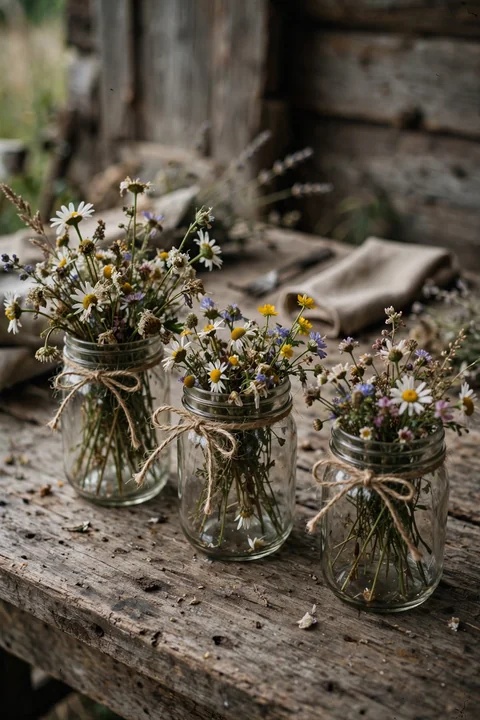
This is the most-built DIY centerpiece in America for a reason: it is nearly impossible to mess up, and it photographs beautifully in natural light.
Materials (per table)
- 3 quart-size mason jars — a 12-pack runs about $12–$15 at Walmart or Target, so roughly $3–$4 per table
- Twine or burlap ribbon — one $4 spool covers every table you will ever make
- 1 bunch of wildflowers or mixed blooms from Trader Joe’s — $5.99 (one bunch covers 1 to 2 tables)
- Flower food packets (usually free with grocery-store flowers)
Steps
- Wash the jars and soak off the labels in warm soapy water; a dab of cooking oil removes any sticky residue.
- Wrap twine 3 to 4 times around the neck of each jar and tie a small bow. For a softer look, glue a 2-inch band of burlap around the middle instead.
- Fill each jar two-thirds full with cool water and stir in flower food.
- Trim stems at a 45-degree angle. Make the middle jar tallest and the two side jars slightly shorter for a natural triangle shape.
- Cluster the three jars in a tight triangle in the center of the table. Done.
Pro tip: buy one extra flower bunch for every four tables — full jars are what separate “homemade” from “handmade.” Assemble the day before and store in the coolest room.
Style 2: Modern Single-Stem Bud Vases
Best for: minimalist, modern, city loft, and gallery weddings. Cost per table: $8–$12. Time per table: about 5 minutes. Difficulty: the easiest style on this list.
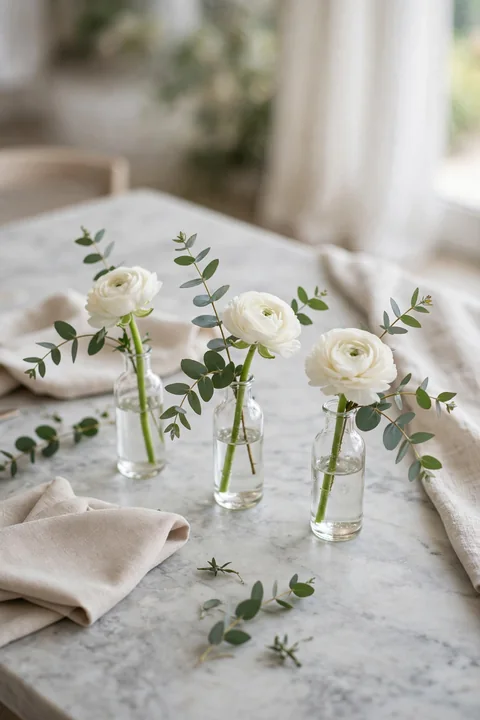
Minimalism is your budget’s best friend. Three tiny vases with single stems look deliberate and expensive, and there is almost nothing to arrange — which means nothing to get wrong.
Materials (per table)
- 3 small bud vases — $1.25 each at Dollar Tree, or a few dollars each at thrift stores
- 3 statement stems: ranunculus, anemones, garden roses, or lisianthus — a 5-stem ranunculus bunch at Trader Joe’s is about $5.99 and covers 2 tables
- A few eucalyptus sprigs — one $3.99 bunch covers 4 to 5 tables
Steps
- Clean the vases so the glass is spotless — smudges show on small glass.
- Trim each stem to 6 to 8 inches so the bloom sits just above the vase rim.
- Place one hero bloom plus one eucalyptus sprig in each vase.
- Group the three vases in a loose triangle; set one on a small wood block or stack of books for height variation.
Pro tip: going monochrome — all white or all blush — is what makes this style read as luxury. Mixed colors in bud vases tend to look scattered.
Style 3: Boho Pampas & Dried Florals
Best for: boho, desert, fall, and outdoor weddings — anywhere fresh flowers might wilt. Cost per table: $10–$15. Time per table: about 8 minutes. Difficulty: easy.
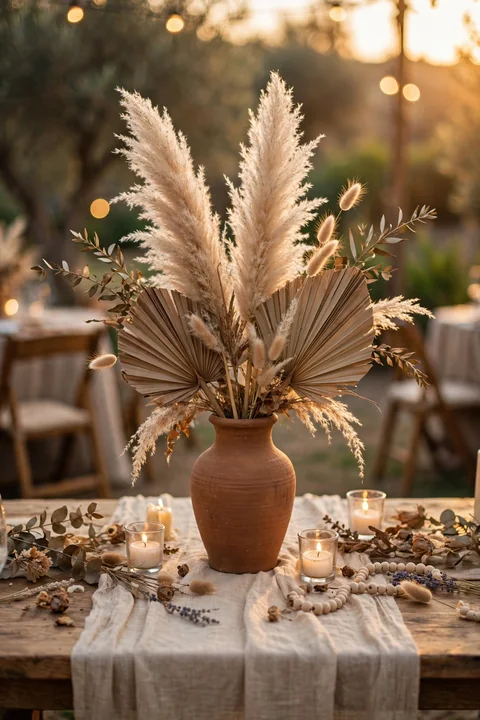
Dried arrangements are the lowest-stress centerpiece you can make. No water, no wilting, no refrigeration — you can build every single one a full week before the wedding and forget about them.
Materials (per table)
- 1 ceramic or terracotta vase, 10–14 inches tall — $8–$12 at HomeGoods or Target, or $2–$4 at thrift stores
- 5–7 pampas grass plumes — a 10-pack on Amazon runs $12–$18 and covers about 2 tables
- Dried accents: bunny tails, dried palm leaves, or preserved ruscus — one bundle covers 3 to 4 tables
Steps
- Take the pampas outside and shake each plume hard — they shed, and you want that over before setup day.
- Trim stems so the plumes fan out 6 to 8 inches above the vase rim.
- Place the tallest plumes in the center, shorter ones around the edges for a full, cloud-like shape.
- Tuck in dried palm leaves or bunny tails at the front for texture contrast.
- Optional: a light mist of hairspray over the finished arrangement cuts shedding dramatically.
Pro tip: pampas grass is flammable — keep these arrangements away from open-flame candles. Pair with LED candles instead, or place real candles at least a foot away.
Style 4: Classic Floating Candle Glow
Best for: romantic evening receptions, ballrooms, and winter weddings. Cost per table: $14–$18. Time per table: about 15 minutes (water goes in on the wedding day). Difficulty: easy, with one timing rule.
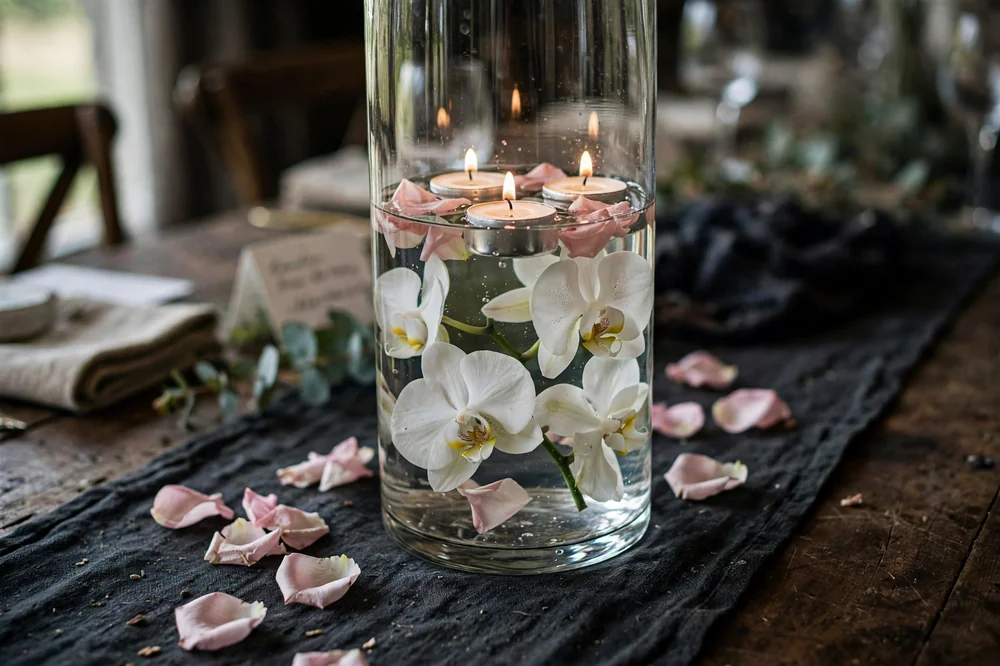
Water, light, and flowers — one of the most photographed centerpiece styles, because candlelight on water flatters everything.
Materials (per table)
- 1 clear glass cylinder vase, 8–10 inches tall — $3–$5 at Dollar Tree or Michaels
- 3 floating candles — $1.25 each at Dollar Tree, or buy in bulk on Amazon for less
- Submerged blooms: white orchid stems, roses, or faux petals — real petals from the grocery store work; faux petals are reusable
- 1 bag of clear glass gems or flat marbles — $1.25 at Dollar Tree
- Submersible LED disc (optional, for extra glow) — a few dollars for a multi-pack
Steps
- Clean the vase with glass cleaner — fingerprints and water spots are very visible in this style.
- Drop in a layer of glass gems, then arrange your submerged blooms and petals.
- Fill the vase three-quarters full with room-temperature water on the wedding day or the night before — earlier, and petals go cloudy.
- Gently set the floating candles on the surface. If using an LED disc, switch it on and drop it in first so it sits under the gems.
- Light the candles 20 to 30 minutes before guests enter the reception.
Pro tip: if your venue bans open flames, LED floating candles exist and look surprisingly real once they are on the water. Buy one extra pack — a few always arrive with dead batteries.
Style 5: The Under-$10 Dollar Tree Bundle
Best for: tight budgets and large guest counts — this is the style that makes 20 tables affordable. Cost per table: $7–$9. Time per table: about 10 minutes. Difficulty: beginner.
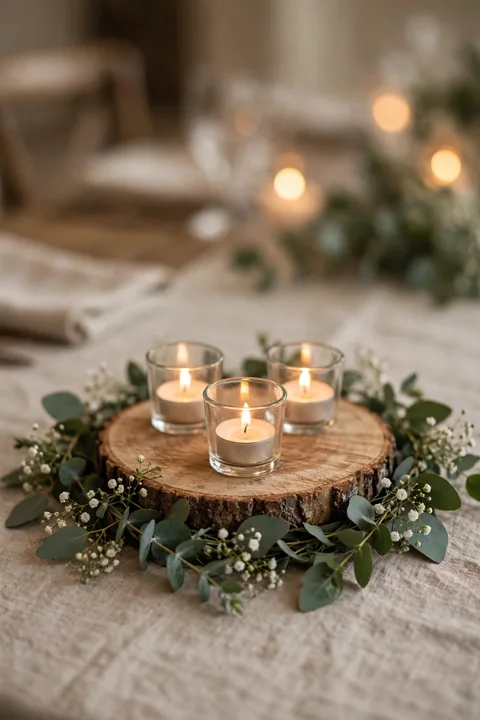
Everything here comes from one Dollar Tree trip. The trick is layering — a wood base, greenery, and candlelight at three heights make $8 of materials look styled.
Materials (per table)
- 1 wood slice, 10–12 inches — $1.25
- 3 small glass votive holders — $1.25 each
- 3 tea lights (real or LED) — a few cents each in bulk packs
- Eucalyptus garland — $1.25 per pack, and one pack cut into sections covers 2 tables
- Baby’s breath — $1.25 per bunch, one bunch covers 2 to 3 tables
Steps
- Set the wood slice in the center of the table as your base.
- Cut the eucalyptus garland into 6- to 8-inch sections and ring them loosely around the slice.
- Tuck small clusters of baby’s breath between the greenery sections for softness.
- Place the three votive holders on and around the slice at slightly different spots — not in a straight line.
- Drop in the tea lights. Light them just before the reception starts.
Pro tip: for 15 tables, this entire style costs roughly $105 to $135 total — less than two florist-made centerpieces. Buy 10 percent extra of everything; Dollar Tree stock varies by store and location.
Cost Per Table, Compared
Here is the full math side by side, including what 15 tables (a typical 120-guest wedding) costs for each style — versus hiring a florist.
| Style | Cost per table | Time per table | 15 tables total |
|---|---|---|---|
| Rustic Mason Jar Trio | $12–$16 | ~10 min | $180–$240 |
| Modern Bud Vases | $8–$12 | ~5 min | $120–$180 |
| Boho Pampas & Dried | $10–$15 | ~8 min | $150–$225 |
| Floating Candle Glow | $14–$18 | ~15 min | $210–$270 |
| Dollar Tree Bundle | $7–$9 | ~10 min | $105–$135 |
| Florist-made (typical) | $75–$150 | 0 min | $1,125–$2,250 |
The savings are not subtle: even the priciest DIY style costs less per table than the cheapest professional option — typically $900 to $2,000 back in your pocket across a full wedding.
Where to Buy Everything in the US
No specialty suppliers needed. Where American couples actually buy centerpiece materials, cheapest first:
- Dollar Tree — glass vases, votive holders, floating candles, glass gems, eucalyptus garlands, wood slices. Everything is $1.25, and you can order full cases online when your local store is picked over.
- Michaels and Hobby Lobby — faux flowers, mason jars, ribbon, twine, and candle holders. Never pay full price: both run 40%-off coupons and weekly sales constantly.
- Trader Joe’s — the cheapest fresh flowers in the country. Bunches run $3.99 to $5.99, and the eucalyptus and baby’s breath are wedding staples. Buy two days before the wedding.
- Costco and Sam’s Club — bulk roses, baby’s breath, and eucalyptus garlands at wholesale prices. Worth it once you are buying for 10+ tables.
- Grocery stores (Kroger, Publix, Whole Foods) — solid day-before fresh flowers, and most will order specific colors if you ask the floral manager a week ahead.
- Facebook Marketplace and OfferUp — search “wedding vases” or “wedding decor” in your city. Recently married couples sell barely-used vessels and candle holders for 50 to 70 percent off retail. Resell yours the same way after.
- Thrift stores (Goodwill, Salvation Army) — brass candlesticks, vintage vases, and ceramic vessels for a few dollars each. Go early in your planning; good pieces go fast.
- Amazon — pampas grass, LED candles, twine, and burlap in bulk when you need identical items for 15+ tables.
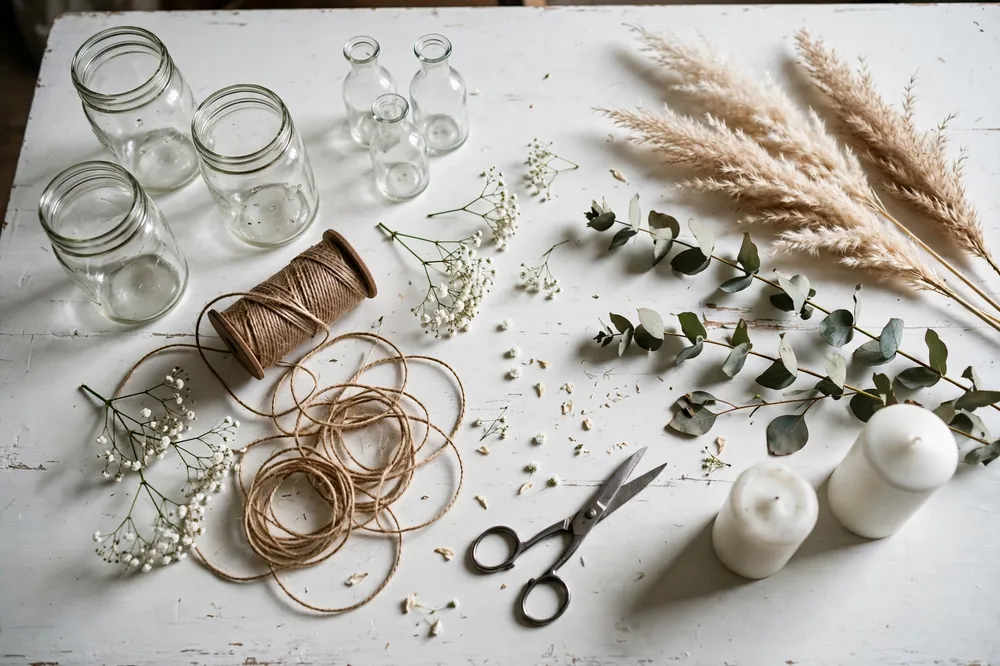
The DIY Timeline: When to Buy, Build, and Set Up
Work backward from your date:
- 2–3 months out: choose your style and buy every non-perishable item — vases, jars, candles, faux or dried flowers, ribbon. Build one complete trial centerpiece and photograph it on your actual table linen if you can. This single test catches every sizing and color mistake before you have bought 15 of everything.
- 1 week out: finish assembling all faux and dried arrangements. Confirm any fresh flower orders with the store’s floral manager.
- 2 days before: buy fresh flowers. Get them into water immediately, trim the stems, and store them in the coolest room available — never in direct sun.
- 1 day before: assembly day. Recruit 2 to 4 helpers and work assembly-line: one person preps vessels, one trims flowers, one arranges. Fresh-flower styles get fully built today.
- Wedding morning: add water to floating-candle vases, transport in boxes with newspaper between vessels, place on tables, and light candles 20 to 30 minutes before guests arrive.
Budget about 5 to 8 minutes per table for setup with a three-person team. Fifteen tables takes roughly an hour — plan it into your getting-ready schedule, not as an afterthought.
Should You DIY or Hire a Florist?
DIY is the right call if your table-decor budget is under $300, you like one of the simpler styles above, and you have two or three reliable helpers for the day before. Hire a florist if you are hosting 150+ guests with elaborate floral designs, you have zero free time the week of the wedding, or your venue requires insured vendors for all decor.
The hybrid works for many couples: DIY the centerpieces, and hire a florist only for the close-up pieces — bouquet, ceremony arch, boutonnieres.
Frequently Asked Questions
How far in advance can I make DIY wedding centerpieces?
Faux and dried arrangements can be built weeks ahead — store them covered so they stay dust-free. Fresh-flower centerpieces should be assembled one day before the wedding and kept in a cool, dark room overnight.
How do I keep fresh flowers alive through the reception?
Condition them in water for at least 24 hours before arranging, use the flower food packets that come with grocery-store bunches, keep finished arrangements out of direct sunlight and away from heating vents, and mist delicate blooms lightly the morning of.
How many centerpieces do I need for 100 guests?
About 12 to 13 for standard 8-person round tables, plus 3 to 5 more for the sweetheart table, welcome table, bar, and cake table. Always make a few extras.
Can I mix two centerpiece styles?
Yes — alternating two styles across tables (for example, mason jar trios on half the tables and floating candles on the other half) looks intentional and eclectic, and it is a good way to use up leftover materials. Keep the color palette consistent so the room still feels cohesive. If you are still choosing colors, see our guide to wedding color palettes.
What if my venue does not allow real candles?
Use LED tea lights, LED floating candles, submersible LED discs, or battery fairy lights in every style above. In photos, guests cannot tell the difference.
Where can I sell my centerpiece supplies after the wedding?
Local wedding Facebook groups and Facebook Marketplace are the fastest options. Vases, candle holders, and faux flowers in good condition typically resell for half of retail within a week or two of listing.
Pick one style and build your trial centerpiece this weekend. If you love the photo, you will love it on your wedding day — and you will have saved over a thousand dollars doing it yourself. Next: our wedding decor on a budget guide.