
Groom Wedding Outfit Guide: Suit vs Tuxedo Rules

Every groom has the same panic moment, usually in a menswear store or a browser tab full of open product pages: do I wear a suit or a tuxedo, and how do I avoid looking like a rental mannequin in the photos? This groom wedding outfit guide answers it end to end: the suit vs tuxedo rules (when each is right, which lapels, which shirts, which shoes), the real buy vs rent cost math in US dollars, a fitting timeline that keeps alterations painless, and a short sherwani section for South Asian American grooms.
Quick orientation: a tuxedo has satin on the lapels, buttons, and a satin stripe down the trouser leg, while a suit is the same matte fabric throughout. That one visual difference drives nearly every rule that follows.
The Groom Wedding Outfit Guide Rule Zero: Read the Venue, the Clock, and the Dress Code
Your outfit choice is not really about taste first; it is about context. Answer three questions and the suit vs tuxedo decision mostly makes itself.
What is the dress code? Black tie means a tuxedo. Black tie optional gives you a real choice: a tuxedo is the safest answer, but a very dark, beautifully fitted suit in charcoal or navy is fully acceptable. Formal or cocktail attire means a suit; semi-formal or garden party means a lighter suit.
What time is the wedding? A tuxedo is evening wear, meaning ceremonies starting after 6 PM. A 2 PM garden wedding in July is a suit wedding, no matter how elegant the guest list.
What is the venue doing to the light? Tuxedo satin comes alive under ballroom chandeliers and goes flat at an outdoor summer afternoon ceremony. Suits photograph beautifully in natural light, where most of your ceremony and portrait photos happen. The groom-specific question: how much do you want to stand out? A tuxedo separates the groom automatically; in a suit, create separation with a waistcoat or elevated details.
Tuxedo Rules: Lapels, Shirts, Shoes, and When It Is Right

When this groom wedding outfit guide says tuxedo, it means the full classic recipe. Here are the rules.
Lapels: peak lapels (pointing upward) are the most formal and flattering on most grooms. Shawl lapels (one smooth curve) are sleek and slightly modern, great for slimmer builds. Notch lapels belong on suits, not tuxedos.
Shirts: a tuxedo shirt has a wing collar or a pleated or pique front, and it takes studs and cufflinks instead of regular buttons. The collar should peek just above the bow tie, and the cuffs should show about half an inch past the jacket sleeve.
Neckwear: a black bow tie, self-tied if you can manage it. A slightly imperfect self-tied bow reads as confident; a perfect clip-on reads as prom. Match the bow tie fabric to the lapel facing: satin to satin, grosgrain to grosgrain.
Color: midnight blue photographs deeper and richer than black under most light, and most grooms look better in it. Black stays the choice for ultra-traditional evening affairs.
The table below puts the whole suit vs tuxedo question in one place. Our broader groom wedding checklist covers the week-before duties that pair with this outfit plan, including your final fitting and ring logistics.
| Rule | Tuxedo | Suit |
|---|---|---|
| Lapels | Satin or grosgrain facing; peak or shawl | Same fabric as jacket; notch or peak |
| Shirt | Tuxedo shirt with studs, wing or pleated front | Regular dress shirt, French cuffs optional |
| Neckwear | Black self-tie bow tie | Long tie or bow tie, your choice of color |
| Shoes | Black patent leather oxfords | Oxfords or derbies; black or dark brown |
| Trousers | Satin stripe, no belt (suspenders) | No stripe, belt or side adjusters |
| Best time of day | Evening, after 6 PM | Daytime or early evening |
| Best dress codes | Black tie, black tie optional | Formal, cocktail, semi-formal |
| Rewear after wedding | Rarely (black tie events only) | High (work, events, other weddings) |
Suit Rules: Colors, Fit, and Getting the Details Right
Most American grooms wear a suit, and a great suit beats a mediocre tuxedo every time. The suit rules in this groom wedding outfit guide are simpler, but the fit bar is higher, because there is no satin to hide behind.
Color first. Navy and charcoal are the two strongest groom suit colors in the US: they suit almost every skin tone, work in every season, and photograph reliably. Medium gray works for daytime and summer weddings; black suits are best reserved for evening ceremonies.
Fit is the whole game. A $400 suit with $120 of tailoring looks better than a $1,200 suit off the rack. The non-negotiables: jacket shoulders end at your shoulders, the sleeve shows half an inch of shirt cuff, trousers have a slight break or no break, and the jacket closes without an X pulling at the button. Shoulders cannot be altered cheaply; everything else can.
Lapels, shirt, tie, and shoes. Peak lapels dress a suit up; notch lapels are the versatile default. A waistcoat elevates a suit toward tuxedo territory and looks sharp when the jacket comes off at the reception. A crisp white shirt is the safest choice and the best for photos; your tie should be darker than your shirt, with the tip just touching the belt line, and a white linen pocket square with a straight fold is the one accessory no groom regrets.
Black oxfords with navy or charcoal; dark brown works with navy and medium gray in daytime. Polish shoes the week before and break in new ones for at least two weeks. Blisters have ruined more wedding days than bad weather.
Buy vs Rent: The Real Cost Math
A standard US tuxedo rental runs $150 to $250 for one night, with online services landing around $200 to $240 all-in once shoes and accessories are included. Buying an entry-level tuxedo starts around $200 to $300; quality ready-to-wear runs $700 to $1,000 before alterations. A good three-piece suit to buy costs $300 to $800 off the rack, plus $75 to $150 in tailoring.
The decision tool in this groom wedding outfit guide is cost per wear: divide the total price by the number of times you will realistically wear it in the next five years.
| Option | Typical US cost | You keep it? | Buy it when… |
|---|---|---|---|
| Rent tuxedo (full package) | $200-$250 all-in | No; return in ~3 days | You will never wear a tux again, or time is short |
| Buy entry-level tuxedo | $200-$350 | Yes | You will wear it even once more |
| Buy quality tuxedo | $700-$1,000+ plus tailoring | Yes | You attend formal events yearly |
| Buy three-piece suit | $300-$800 plus $75-$150 tailoring | Yes | Almost always; it earns its keep fast |
| Rent suit | $100-$200 | No | Budget is tight, dress code casual |
The math most grooms miss: a $250 tuxedo rental worn once costs $250 per wear. A $300 purchased suit worn to your wedding, two friends’ weddings, and a job interview costs $75 per wear, and you still own it. Buying wins the moment you wear it twice.
Rent when: the wedding is black tie and you never attend formal events; your weight is in flux; the wedding is less than a month out. Watch the gotchas: late-return fees, $50 to $75 damage deposits, and generic multi-wear fit. Ask about rent-to-keep programs; some companies let you buy the outfit afterward and credit part of the rental.
Buy when: you will wear it again; rentals never fit you right; or the wedding is 3+ months out. Budget tailoring separately: trouser hemming $20 to $30, taking in a jacket $40 to $75, a full suit alteration package $75 to $150 at most US tailors.
The Fitting Timeline: When to Order and What to Do When
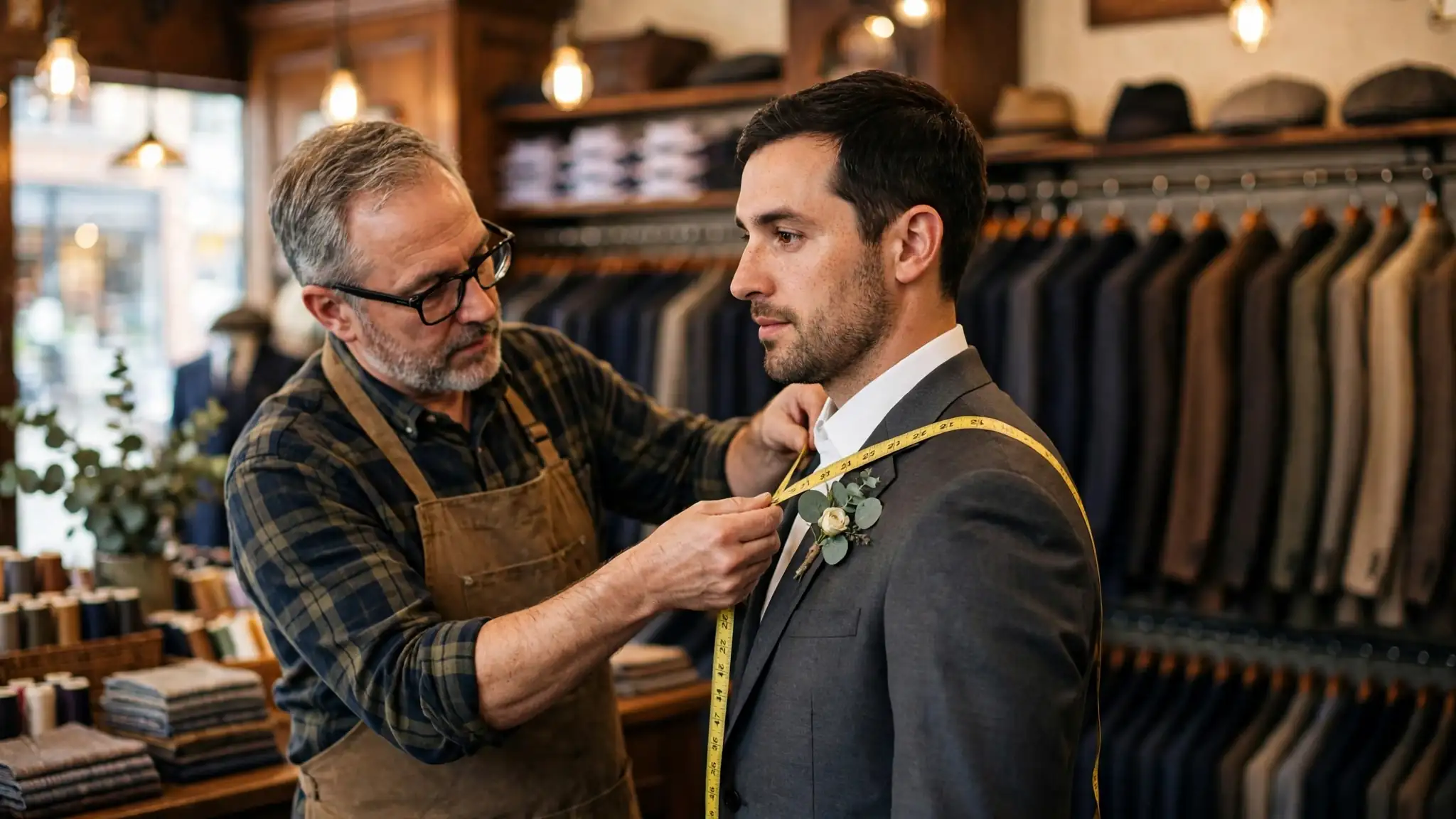
Outfit disasters are almost always calendar disasters. This groom wedding outfit guide works backward from the wedding date.
4 to 6 months out: decide and order. Choose suit vs tuxedo, pick your color and lapel style, and place the order. Made-to-measure suits need 6 to 8 weeks; custom tuxedos need 8 to 12. Popular sizes sell out in US wedding season (May, June, September, October).
6 to 8 weeks out: first fitting. Try everything on together and mark every alteration. If renting, the shop takes measurements now; online services ship a home try-on around this window.
2 weeks out: final fitting. Confirm the trouser break with your actual wedding shoes on, since heel height changes the hem. Confirm the rental delivery date (usually about 14 days before the wedding for online services) or pick up your purchase.
3 to 5 days out: the full dress rehearsal. Try the complete outfit on once more at home, steam out wrinkles, and polish the shoes. Pack everything on good hangers in a garment bag, with accessories in a labeled pouch. Our wedding dress shopping guide makes the same point for brides: the final try-on is about confidence, not changes.
For South Asian American Grooms: The Sherwani Option
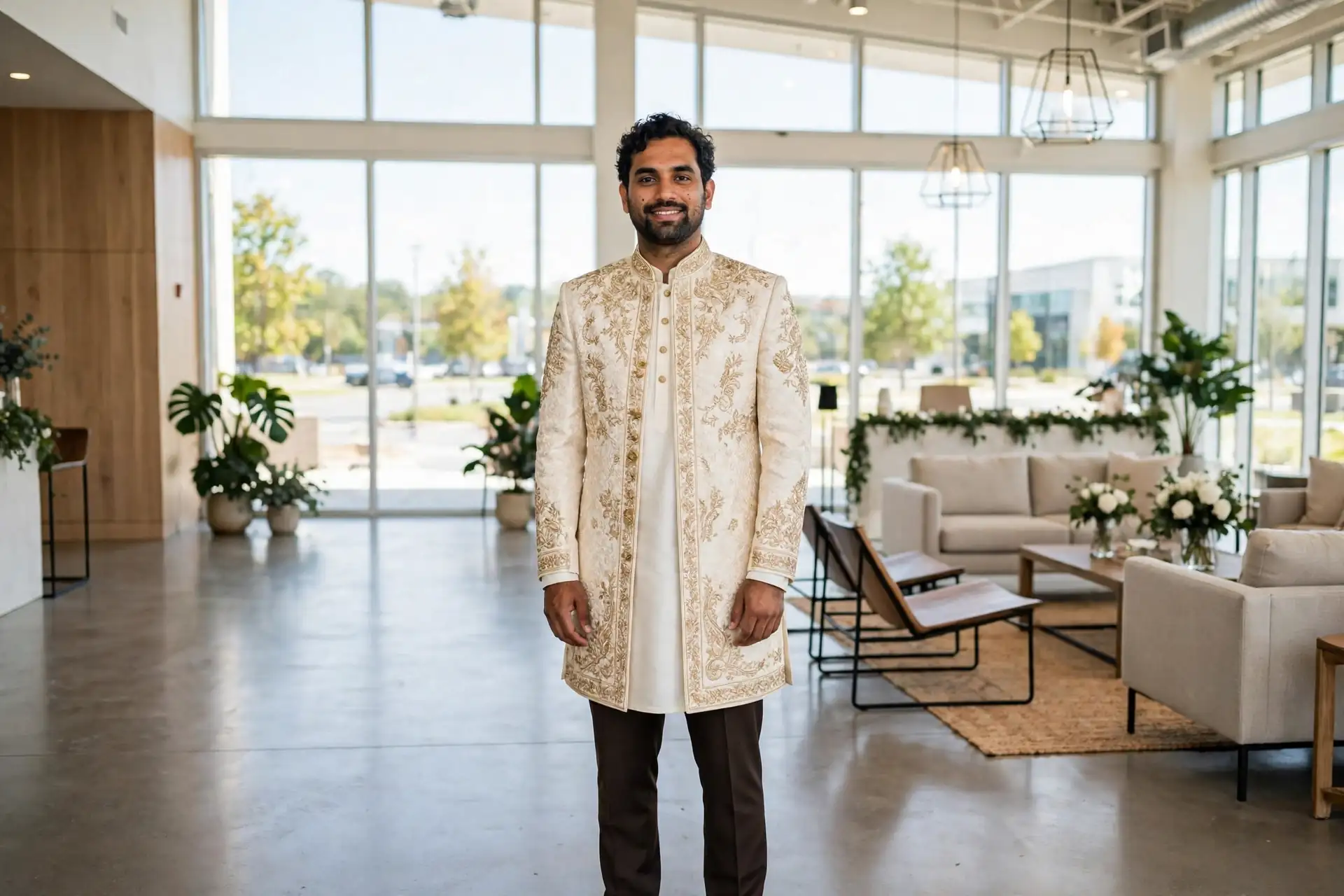
This section of this groom wedding outfit guide is for one specific groom: the South Asian American getting married in the US who wants to honor his heritage without flying abroad for the outfit. A sherwani, the long structured coat worn over a kurta with churidar or straight trousers, is the traditional groom’s outfit for Indian and Pakistani weddings, and wearing one at a US wedding is completely mainstream now.
Fabrics and what they cost. In the US market, expect roughly $250 to $350 for a simple suiting-fabric sherwani, $400 to $650 for embroidered raw silk or jamawar pieces, and $600+ for heavy designer styles. A matching turban and khussa or mojari shoes are usually add-ons, $30 to $100 each.
Where to source one in the US. Three routes: South Asian menswear showrooms in New York, New Jersey (Edison/Iselin), Chicago (Devon Avenue), Houston, and the Bay Area; made-to-measure online sellers shipping custom sherwanis to the US in 3 to 6 weeks; or buying during a family trip to India or Pakistan, often the best value but needing a 2 to 3 month lead time before you travel.
Fitting a sherwani in America. Unlike Western tailoring, the sherwani should skim the body, not hug it, with the length hitting around the knee and the collar standing clean at the neck. If you order made-to-measure online, get measured by a local tailor (most US alteration shops will measure you for $15 to $25) rather than guessing. Order 8 to 12 weeks out; international shipping plus local tweaks eats more calendar than you expect. Many grooms wear the sherwani for the ceremony and change into a tuxedo or suit for the reception, which gives you both traditions and doubles your photo variety. Coordinate, do not match, with your partner’s outfit: complementary tones, not identical colors.
Coordinating with Your Groomsmen (Without Looking Like Staff)

The groom should be recognizable in every photo. The rule is simple in this groom wedding outfit guide: groomsmen coordinate, the groom elevates. If the groomsmen wear navy suits with long ties, you wear the navy three-piece with a bow tie, or the tuxedo while they wear suits. If everyone rents the same tuxedo, differentiate with a different boutonniere, a waistcoat, or an ivory dinner jacket.
Decide early who pays for what. In the US, groomsmen traditionally pay for their own rental or purchase, and the groom covers accessories he is dictating (matching ties, pocket squares, boutonnieres). A full groomsman rental package runs $150 to $250 per person; tell your crew the number early so nobody is surprised. Give groomsmen a deadline, not a suggestion: measurements or orders in 8 weeks out, final try-on 2 weeks out. One groomsman in an ill-fitting rental will pull focus in every group photo. This kind of crew coordination sits naturally inside your wedding planning checklist timeline, where attire deadlines live alongside vendor bookings.
Your Groom Outfit Checklist: The Short Version
Decide suit vs tuxedo from the dress code, venue, and start time. Learn the rules for your choice in this groom wedding outfit guide: satin details, correct shirt, right shoes. Run the cost-per-wear math before you rent or buy. Order 4 to 6 months out, fit at 6 to 8 weeks, finalize at 2 weeks. Elevate slightly above your groomsmen, break in your shoes, and walk in knowing every detail was decided weeks ago.