Wedding Dress Shopping Guide: Find the One Without the Stress

Finding your wedding dress should feel like the fun part of wedding planning, and it can be, if you walk in prepared. This wedding dress shopping guide covers the five decisions that determine everything else: your budget, your silhouette, your fabric, your timeline, and your alterations. Get those right and the appointments themselves become the easy, champagne sipping part. Bookmark this wedding dress shopping guide so you can revisit each step as your appointment dates approach.
Here is the honest truth most boutiques will not tell you up front. The price on the tag is rarely the price you pay. Between alterations, the veil, shoes, and undergarments, the final number lands 30 to 50 percent above the sticker price. Brides who know that on day one shop calmly. Brides who find out at the register shop stressed. This wedding dress shopping guide makes sure you are in the first group.
Wedding Dress Shopping Guide: Set Your Real Budget Before You Step Into a Boutique
In the US, most brides spend between $1,500 and $2,500 on the gown itself, with the national average sitting near $2,250. That is the gown only. A realistic rule is to keep your entire bridal look, dress plus everything below, under 10 percent of your total wedding budget. If you have mapped out your numbers in a wedding budget breakdown, pull up the attire line before you book a single appointment. This wedding dress shopping guide starts with the budget because the budget decides everything that follows.
Here is what typical US price tiers actually buy:
| Tier | Typical price range | What you get | Example retailers |
|---|---|---|---|
| Budget | Under $500 | Simple made to order gowns, bridesmaid dresses in white, pre-owned designer gowns at 50 to 70 percent off retail | Azazie, department store sales, pre-owned marketplaces |
| Mid-range | $500 to $1,200 | The sweet spot for most US brides: well made gowns with real structure, good lace, and clean finishing | David’s Bridal, Azazie atelier lines, BHLDN sale styles |
| Premium | $1,200 to $2,500 | Designer labels, imported lace, hand finished details, wider size and silhouette ranges | BHLDN, Maggie Sottero and Allure Bridals at independent boutiques |
| Couture | $2,500 and up | Flagship designer gowns, custom couture, runway pieces with hand beading and French lace | Kleinfeld, Mark Ingram, Pronovias flagship |

Then add the costs that never appear on the price tag:
- Alterations: $150 to $800 depending on complexity (see the alteration menu below)
- Veil: $50 to $400 at a boutique, often less online
- Shoes: $50 to $300
- Undergarments and shapewear: $40 to $150
- Steaming or pressing before the wedding: $50 to $150
- Cleaning and preservation after the wedding: $150 to $350
Decide your ceiling for the gown and your ceiling for the whole look, and tell your stylist both numbers at the start of the appointment. A good stylist will respect them. A stylist who keeps pulling dresses 40 percent over your number is telling you everything about that shop.
Wedding Dress Shopping Guide: Use the Silhouette Finder, Not the Alphabetical List
Every guide lists the same seven silhouettes in the same order. That does not help you choose. Use this instead: find your top priority, then start with the two silhouettes listed for it. Unlike most lists, this wedding dress shopping guide skips the alphabetical order and starts with your priority instead.
| If your priority is | Start with | Why |
|---|---|---|
| Classic and flattering on almost everyone | A-line | Fitted bodice, skirt flares gently from the waist; skims hips and thighs without heavy volume |
| Maximum drama and a fairy tale entrance | Ball gown | Full skirt with tulle or crinoline layers; check your venue first, since it needs space and a wide aisle |
| Showing off your curves | Mermaid or trumpet | Mermaid flares at or below the knee for the most drama; trumpet flares at mid-thigh and is easier to walk and dance in |
| Modern, minimal, and easy to move in | Sheath or column | Follows the body without flare; clean lines that photograph beautifully in city and industrial venues |
| Comfort for a long day on your feet | A-line or empire waist | Both let you sit, eat, and dance without fighting the dress; the empire waist sits under the bust and flows over the midsection |
| Petite friendly (under about 5 foot 4) | Sheath, trumpet, or simple A-line | Less fabric reads taller; skip dropped waistlines, which visually shorten the torso |
| Outdoor, beach, or garden wedding | Sheath, slip, or light A-line in chiffon | Heavy ball gowns drag in sand and grass and trap heat; lightweight skirts move with the breeze |
| Vintage or retro feel | Tea-length or fit-and-flare | Tea-length hems fall between knee and ankle; fit-and-flare hugs the torso then widens gradually for a 1950s line |

Two things to know before you fall in love with a silhouette online. First, most brides buy a different silhouette than the one they pictured, because the mirror changes minds. Try your dream shape plus its opposite. Second, think about necklines at the same time. A V-neck adds visual height for petite brides, a strapless sweetheart suits almost every bodice, and illusion lace sleeves solve the coverage question without a separate wrap.
Wedding Dress Shopping Guide: What Each Fabric Actually Does on Your Body
Fabric decides how the dress moves, photographs, wrinkles, and alters. These are the eight you will meet in US boutiques, with the practical notes stylists share after the sales pitch ends. No wedding dress shopping guide is complete without the fabric truth, and here it is, straight from the fitting room.
Satin. Smooth with a luminous surface. Holds its shape, photographs like liquid, and suits ball gowns and classic A-lines. Watch for: it shows every line underneath, so undergarments must be seamless, and it creases if you sit through a long ceremony.
Crepe. Matte, smooth, with a slight grain. The modern minimalist fabric for sheaths and fit-and-flare gowns. Watch for: fitted crepe shows lines too, but it is one of the easiest fabrics to alter, which keeps tailoring bills down.
Mikado. A heavier, crisper cousin of satin with a subtle sheen. Holds sculptural, architectural shapes without collapsing. Watch for: it is warm and heavy, so think twice for a July outdoor wedding.
Lace. The romantic default, from fine Chantilly to bold Alencon corded lace. Used for overlays, sleeves, and full gowns. Watch for: beaded lace is the most expensive fabric to alter, because every seam means removing and reapplying beads by hand. A heavily beaded bodice can add hundreds of dollars to your alteration bill.
Chiffon. Light, sheer, and floaty. Made for beach, garden, and destination weddings. Watch for: it snags on jewelry, it needs a lining, and it wrinkles in transit.
Organza. Crisp and sheer with real body. Gives skirts airy volume without weight. Watch for: the cut edges can feel scratchy against bare arms.
Tulle. Fine netting, from cloud soft to stiff. Builds ball gown volume and veils for very little money. Watch for: layered tulle hems take longer to alter, and tulle tears if it catches on anything sharp.
Charmeuse. Liquid and slinky with a glossy face. The fabric of bias-cut slip dresses. Watch for: it shows every ripple, so the fit must be exact and the undergarments perfect.
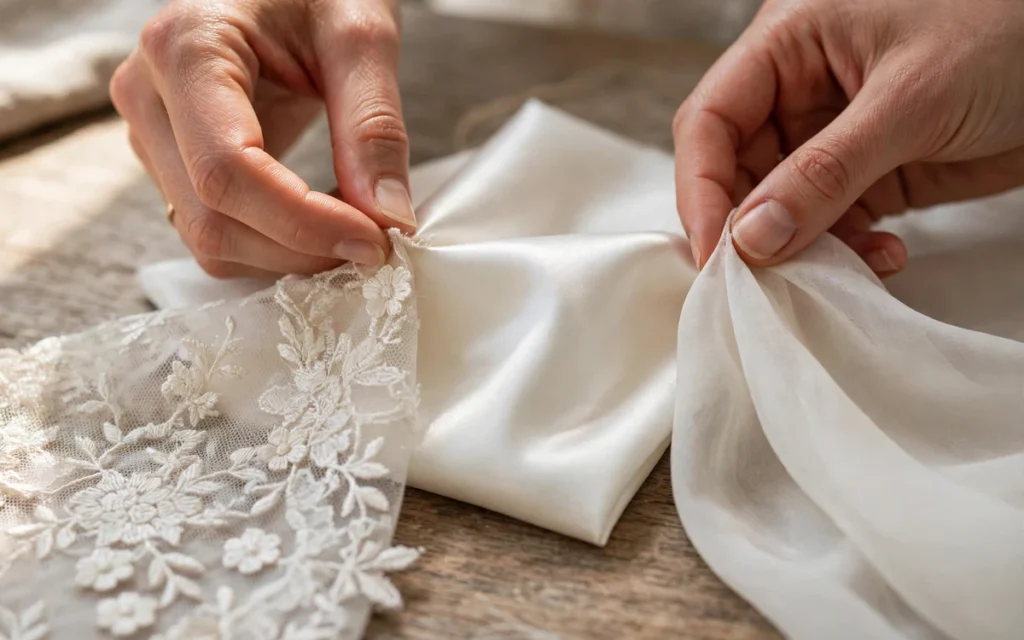
Match the fabric to the setting before you match it to the trend. Chiffon and tulle breathe for summer and outdoor weddings; mikado and satin bring the formality a ballroom expects. And let your wedding color palette weigh in too: ivory and champagne tones glow in warm fabrics like satin and mikado, while crisp white pops against cool, matte crepe.
Wedding Dress Shopping Guide: When to Order Your Dress
The standard US advice is to order 8 to 10 months before the wedding, and it exists for a reason. Most gowns are made to order, not pulled from a warehouse. Production takes 4 to 6 months, shipping adds a few weeks, and alterations need 6 to 8 weeks with 2 to 3 fittings. Work backward from there:
- 12 or more months out: Research silhouettes and fabrics, save inspiration, and shortlist boutiques. Book appointments 2 to 3 months ahead for popular shops, especially Saturday slots in spring.
- 9 to 10 months out: Shop in earnest. Try a wide range, narrow to favorites, and place your order. Confirm the delivery date in writing and ask about the deposit, the cancellation policy, and whether rush production is available.
- 6 to 8 months out: Your gown is in production. Use this window to choose your veil, shoes, and undergarments, because the final hem length depends on your exact shoe height.
- 2 to 3 months out: First fitting. Bring your wedding shoes and the exact undergarments you will wear. The seamstress pins the hem, takes in or lets out the bodice, and plans the bustle.
- 4 to 6 weeks out: Second fitting. Check the structural changes, then walk, sit, and dance in the dress. This is when problems surface while there is still time to fix them.
- 2 weeks out: Final fitting and pickup. The gown should be cleaned, pressed, and ready. Store it in a breathable garment bag, never plastic, in a cool room away from sunlight.
Short engagement? You still have options. Sample sales routinely cut 40 to 70 percent off floor samples you take home that day. Off-the-rack lines at David’s Bridal and Azazie ship in weeks, not months. Pre-owned gowns sell for 50 to 70 percent below retail. And most boutiques offer rush production for a fee, usually a few hundred dollars, which can compress the timeline to about 3 to 4 months.
One more US-specific reality: bridal sizing is not street sizing. Wedding gowns typically run 1 to 2 sizes larger than the size you buy in regular clothes, so a street size 8 often orders a bridal 10 or 12. Ignore the number on the tag and order to your largest measurement. Taking a dress in costs far less than letting one out. Slot every one of these milestones into your wedding planning checklist so the dress never becomes the thing you scramble to finish.
Wedding Dress Shopping Guide: The Appointment Playbook for Trying On Dresses
Book 2 to 3 appointments at different types of shops: one big retailer, one independent boutique, and one wild card. More than that in a single weekend and the dresses blur together. Sixty to 90 minutes per appointment is standard, and most US boutiques ask you to book ahead rather than walk in.
What to wear and bring: nude seamless underwear and a strapless bra or the shapewear you plan to wear, so every dress reads true. Bring shoes at your planned heel height, or a pair close to it, because hem length is set to the shoe. Bring hair ties or clips so you can see necklines clearly. And bring your phone, but ask about the photo policy first. Some boutiques ban photos to protect designer exclusivity, and arguing about it sours the appointment.
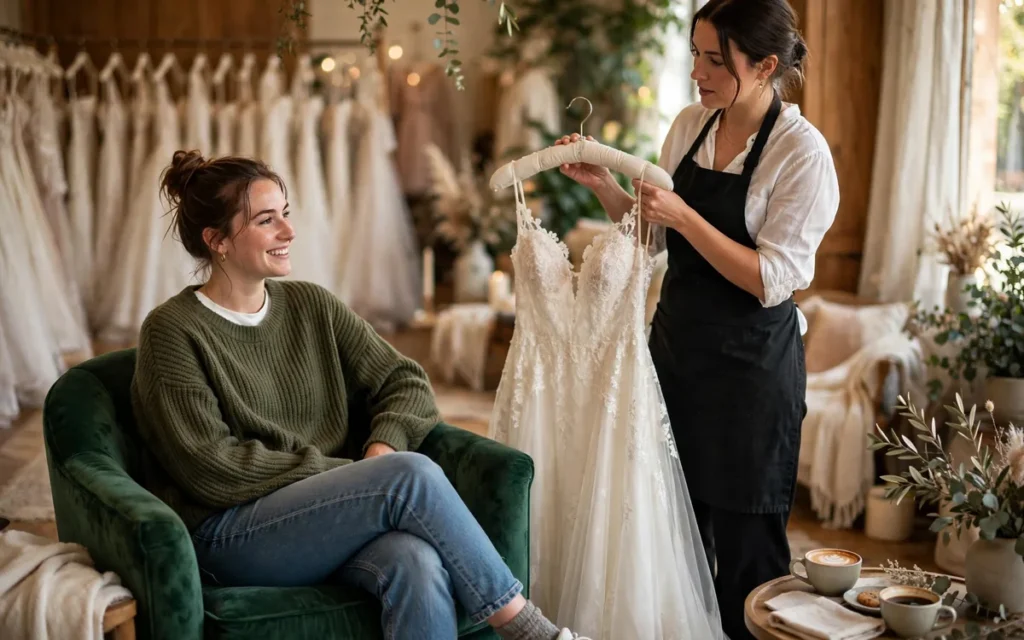
Who to bring: two or three people whose taste you trust and whose opinions will not overwhelm yours. The entourage of eight makes great television and terrible decisions. Tell your group your budget before you arrive so nobody falls in love with a dress you cannot buy.
Try-on rules that save the day: eat before you go, because low blood sugar ruins judgment. Try your dream silhouette and its opposite. Move in every contender: sit, raise your arms, walk briskly, and pretend to hug someone. A dress that only looks good when you stand perfectly still is a dress you will resent by the reception.
And the big one: do not let anyone rush your yes. The “this dress is being discontinued” and “the trunk show discount ends today” lines are sales tactics, not facts you can verify in the moment. Sleep on it if you need to. The right dress will still feel right on Tuesday. It is the single most repeated piece of advice in any wedding dress shopping guide worth following.
Wedding Dress Shopping Guide: Alteration Costs, the Price Menu Nobody Shows You
Nearly every wedding dress needs alterations. Gowns are cut for a standard pattern, not for your body, and even a made-to-measure dress gets fine tuned. Budget $400 to $800 for typical alterations on top of the dress price. Here is what individual services usually run in the US:

| Alteration | Typical cost | Notes |
|---|---|---|
| Hemming, simple skirt | $100 to $250 | The most common alteration; priced by layers |
| Hemming, layered or lace edge | $250 to $400 | Lace motifs must be removed and reapplied by hand |
| Taking in the bodice | $100 to $200 | Standard reshaping through the waist and bust |
| Taking in or letting out the waist | $80 to $175 | Letting out is limited by the seam allowance inside |
| Adding a bustle | $75 to $175 | Lifts the train for the reception; essential for dancing |
| Adding cups or boning | $50 to $125 | Often removes the need for a separate bra |
| Shortening straps | $30 to $75 | Quick fix with big comfort payoff |
| Adding sleeves | $150 to $350 | Priced by fabric; lace sleeves cost more to match |
| Rush fee | $50 to $200 | Charged when fittings start under 6 weeks out |
Ask for the full estimate at your first fitting, in writing, before any work begins. Ask whether the boutique uses an in-house seamstress or an independent tailor; independents are often cheaper and sometimes better, because bridal alteration specialists see hundreds of gowns a year. And remember the fabric math from earlier: beaded lace, layered tulle, and hand applique all push labor hours up, while crepe and simple satin keep them down.
Wedding Dress Shopping Guide: Protect the Dress After You Buy
Get an itemized receipt with the designer, style number, size ordered, color, delivery date, and every fee. Photograph it and email it to yourself. If the gown is expensive, ask your homeowner’s or renter’s insurance about a short-term rider; some US policies cover special occasion attire for a small add-on.
Between pickup and the wedding, store the gown in its breathable garment bag in a cool, dark room. Keep it off the floor, away from pets, and away from direct sunlight, which yellows white fabric. Do not try it on repeatedly in the final weeks; body fluctuations near the wedding are normal, and your final fitting already accounts for the fit.
After the wedding, budget $150 to $350 for professional cleaning and preservation if you want to keep the gown. Preservation boxing seals the cleaned dress in acid-free tissue inside an archival box, which is what keeps it from yellowing over the years. Book the cleaning within a few weeks of the wedding, because stains set with time, especially sugar, sweat, and champagne.
Walk in knowing your real budget, your priority silhouette, the fabric that suits your venue, and the timeline working backward from your date, and wedding dress shopping becomes what it should be: the most enjoyable appointment of the whole planning process. Say yes to the dress, and to the plan that got you there. Use this wedding dress shopping guide one last time before you go, and enjoy every appointment.