How Much Should You Spend on an Engagement Ring?

Somewhere between the proposal planning and the ring shopping, one question starts to feel heavier than all the rest: how much should you spend on an engagement ring? You have probably heard a rule, maybe two months’ salary, maybe three, quoted with total confidence by someone who never checked where it came from. The honest answer is simpler and kinder than the rule: spend what you can pay for in cash without going into debt.
In 2026, American couples who married in 2025 spent an average of about $4,600 on an engagement ring, according to The Knot’s 2026 Real Weddings Study of more than 10,000 couples, and most spent far less than that. This guide walks through the real spending data, where the old salary rule came from, what drives the price of a ring, and how to get a ring she will love at a number your bank account will also love.
How Much Should You Spend on an Engagement Ring? The Short Answer
Start here: most American couples spend between $3,000 and $6,500 on an engagement ring. The averages quoted online disagree because they measure different things. The Knot’s survey of couples married in 2025 found $4,600. BriteCo, which works from jewelry appraisals rather than receipts, put the 2025 appraised average at $6,504. The Natural Diamond Council’s 2025 industry survey landed at $7,364. All three point the same direction: the typical buyer spends a few thousand dollars, not a few months of pay.
The distribution matters more than any average, because averages get pulled upward by a small group of very big spenders. The Knot’s 2024 Jewelry and Engagement Study found that 33 percent of buyers spent under $3,000 and 64 percent spent under $6,000. Only about 8 percent spent between $10,000 and $14,999, and roughly 5 percent spent more than $15,000. In other words, if your budget is $2,500, you are not the exception. You are the typical buyer, standing right in the middle of the crowd.
Spending has also been drifting down for four straight years, from $6,000 in 2021 to $4,600 in 2025. The main reason is lab-grown diamonds, which now make up 61 percent of engagement ring purchases, up 239 percent since 2020. They let buyers get a bigger, brighter stone for much less money.
The Two Months’ Salary Rule Is a Marketing Invention
Let us kill the myth properly, because it is the single biggest source of ring-budget anxiety in America. The months-of-salary rule was not handed down by tradition, and no financial planner ever endorsed it. It was invented by a diamond company.
In the 1930s, De Beers and its advertising agency set out to make diamond engagement rings feel mandatory, and the “A Diamond Is Forever” campaign, launched in 1947, turned the diamond ring into the default symbol of commitment. The first version of the rule said one month’s salary. By the 1980s, the ads quietly upgraded it to two months’ salary. A three months’ salary version floats around today with no source at all. It is a revenue target dressed up as etiquette.
Here is what the rule would actually cost at real 2026 American wages. The median full-time weekly wage in the United States is about $1,251, which works out to roughly $65,000 a year. Run the rule against that income and against higher and lower incomes, and the gap between the myth and reality becomes impossible to ignore:
| Rule | $50,000 income | $65,000 income (US median) | $100,000 income | Where it came from |
|---|---|---|---|---|
| One month’s salary | $4,167 | $5,417 | $8,333 | De Beers ads, 1930s |
| Two months’ salary | $8,333 | $10,833 | $16,667 | De Beers ads, 1980s |
| Three months’ salary | $12,500 | $16,250 | $25,000 | No source, just inflation of the myth |
| What couples actually spend | About $4,600 on average; one-third spend under $3,000 | The Knot 2026 Real Weddings Study | ||

At the median American income, two months’ salary is about $10,833, more than double what the average couple actually spends. At $100,000 a year, the rule demands nearly $17,000. Almost nobody follows it: in a 2026 survey, only 24 percent of married or engaged people had spent three months’ salary on a ring. The rule also ignores the only thing that determines what you can afford: your debts, your rent, and your savings. A teacher with $30,000 in student loans and $1,800 a month in rent has a completely different safe number than an engineer with no debt and six months of expenses saved, even if their salaries match. No salary multiple can see that difference. Your budget can.
What Americans Actually Spend, by Income and Situation
There is no single right number, but there is a useful test: the ring should be payable from savings you already have, or from savings you can build in three to six months, without touching your emergency fund and without putting any of it on a credit card. If the number that passes that test is $1,800, then $1,800 is the right budget. If it is $7,000, then $7,000 is fine too. The ring does not know what you paid for it.
A few patterns from the survey data are worth knowing before you set your number:
- Under $3,000 is normal. One-third of buyers land here. This budget buys a beautiful ring, especially with a lab-grown center stone.
- $3,000 to $6,000 is the crowded middle. About another third of buyers sit in this band, where most lab-grown rings with a 1.5 to 2 carat center stone live.
- $6,000 to $10,000 is the premium tier. This is where natural diamonds in the 1 to 1.5 carat range and designer settings appear.
- Over $10,000 is rare. Fewer than one in seven buyers go here, and only because they genuinely want to, not because a rule told them to.
- Debt is common, and it is a warning sign. About one in three buyers take on some debt for the ring, while only about one in four pay entirely from savings. If a ring requires financing, the budget is too high. A ring bought on a store card at 25 percent interest is not a $5,000 ring. It is a $6,000 ring that also costs you sleep.
What You Spend Depends on Where You Live
Engagement ring spending is not flat across the country. The Knot’s regional data puts the Mid-Atlantic among the highest-spending regions, averaging around $6,900, while the Midwest sits closer to $4,900. A Blue Nile analysis of sales by state found an even wider spread, from about $3,406 on average in Wyoming to $9,329 in Vermont, nearly a threefold difference. Big-city jewelry districts and higher local incomes push the numbers up in places like New York and San Francisco, while smaller markets stay closer to the national middle.
None of that means you should spend your region’s average. Jewelers stock what their neighborhood buys, so a store in Manhattan will show you $8,000 rings before it shows you $3,000 rings, and a store in Milwaukee will do the reverse. The number that matters is the one you walked in with, not the one on the velvet tray in front of you. Online retailers make this easier, since the same ring costs the same whether you shop from Ohio or Oregon.
Where the Money Goes: Stone, Setting, and Metal
A ring’s price tag is three things stacked together, and knowing the split is how you move money toward what she will actually see. The center stone is the biggest piece by far, usually 70 to 85 percent of the total price. The setting is the next chunk, then the metal and any small side stones. Retailer markup sits on top of all three.
The stone’s price is set by the 4Cs: cut, color, clarity, and carat weight. Each one has a point where spending more stops buying visible improvement, and that point is where smart buyers stop:
- Cut is the one C never to cheap out on. An Excellent or Ideal cut is what makes a diamond sparkle. A well-cut 0.90 carat diamond will outshine a poorly cut 1.20 carat stone in any light. Cut does the visible work.
- Color has a sweet spot at G or H. Diamonds are graded from D (colorless) to Z (visibly tinted). D to F stones cost a premium, but a G or H stone faces up white to the naked eye once it is set. You pay thousands less for a difference nobody can see without a grading report.
- Clarity has a sweet spot at VS2 to SI1. These grades are eye-clean, meaning no inclusions are visible without a jeweler’s loupe. Paying for flawless buys perfection you need magnification to appreciate.
- Carat weight is where the price jumps. Prices jump at round weights like 0.50, 1.00, 1.50, and 2.00 carats, because demand clusters at those thresholds. A 0.90 or 0.95 carat stone looks identical to a 1.00 carat stone on the hand but can cost 15 to 20 percent less. Jewelers call this buying shy, and it is the easiest money in ring shopping.
- Shape matters more than people think. Round brilliants are the most popular shape and the most expensive. Oval, cushion, emerald, and pear shapes typically cost 10 to 30 percent less per carat, and an oval or emerald cut can look larger than a round stone of the same weight.
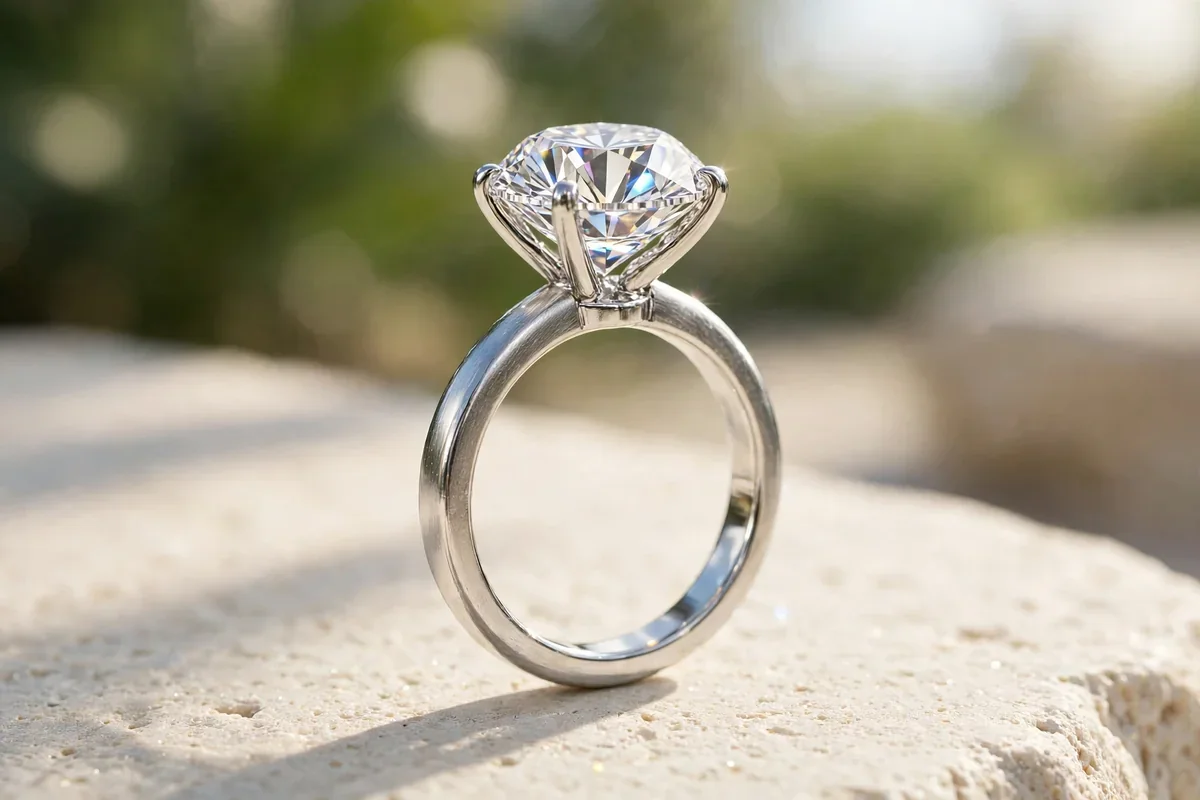
The setting is the second lever. A classic solitaire, one center stone on a plain band, is the least expensive setting and keeps the focus and the budget on the stone. Halo settings add $500 to $1,500 or more, and pavé bands add hundreds per side. Both are beautiful, and both are optional. A solitaire with a great stone beats a halo with a mediocre stone every time.
Metal is the third lever. Platinum is durable and naturally white, but it typically costs $500 to $1,000 more than the same ring in 14k white gold. Fourteen karat white gold looks nearly identical and costs much less, though it needs re-plating with rhodium every year or two, usually $60 to $100 a visit. Yellow and rose gold skip the plating entirely, and 14k is the value pick for a ring worn every day.
Lab-Grown vs Natural Diamond: The Price Math That Changes Everything
No single decision moves the price of an engagement ring as far as choosing a lab-grown diamond over a natural one. A lab-grown diamond is a real diamond: the same crystal structure, hardness, and brilliance, grown in a lab instead of mined from the earth. It carries GIA and IGI certifications graded on the same 4Cs scales, and a jeweler’s loupe cannot tell it apart from a natural stone. The Federal Trade Commission requires retailers to disclose lab origin clearly. The difference is price, and it is enormous.

| What you are buying | Natural diamond | Lab-grown diamond | You save |
|---|---|---|---|
| 1.00 ct round, Excellent cut, G color, VS2 clarity (loose stone) | $3,800-$4,200 | $800-$1,000 | About 75-80% |
| 2.00 ct round, same quality (loose stone) | $16,000-$17,500 | $3,500-$7,500 | About 60-75% |
| Complete ring, average (The Knot 2026) | About $7,000 | About $4,300 | About $2,700 |
| Complete ring, average appraised value (BriteCo 2025) | $10,760 | $5,188 | About $5,573 |
| Average center stone size buyers choose | 1.6 carats | 2.0 carats | Bigger stone, lower price |
| Resale value as a share of purchase price | 40-60% | 10-20% | Natural holds value better |
Notice the last row, because it is the real trade-off. Lab-grown prices keep falling as production grows, so resale value is weak: expect 10 to 20 percent of what you paid, versus 40 to 60 percent for a natural stone. If you are buying the ring to wear for a lifetime, that barely matters. A third option for tighter budgets is moissanite, a different gemstone that costs a fraction of even a lab-grown diamond, though it sparkles differently and is not a diamond at all. Lab-grown gives you the look and certificate of a diamond at a third of the price; natural gives you tradition and resale value at a steep premium.
What Each Budget Actually Buys
Here is what real 2026 money buys in a finished ring, assuming a 14k gold solitaire setting and an Excellent cut stone:
- $1,000 to $1,500: A 0.50 to 0.75 carat lab-grown diamond in a simple solitaire. Complete 1 carat lab-grown rings start around $1,490 at major online retailers. This is a genuinely beautiful ring.
- $2,000 to $3,000: A 1 to 1.5 carat lab-grown diamond in a solitaire or simple pavé setting, or a small natural diamond under 0.50 carats. This is the most common budget in America.
- $4,000 to $5,000: A 2 carat lab-grown diamond in a halo or cathedral setting, or a 1 carat natural diamond in a solitaire. Right around the national average.
- $6,000 to $8,000: A 2.5 to 3 carat lab-grown stone in a designer setting, or a 1.25 to 1.50 carat natural diamond. The premium tier.
- $10,000 and up: A 1.50 to 2 carat natural diamond in a high-end setting, or a 3 carat-plus lab-grown showpiece. Fewer than one in seven buyers spend here, and only because they love the stone.
Remember to budget past the ring itself: the average American wedding now runs about $36,000 all in, so your ring budget should leave room for everything after it, from the venue to the photographer. Our wedding budget breakdown shows where the rest of the money usually goes, so the ring does not accidentally eat the photography budget. And once the proposal is planned, our proposal ideas guide and engagement photos guide pick up right where the ring shopping ends.
7 Ways to Spend Less Without a Ring That Looks Cheap
The strategies below stack. Use one and you save hundreds. Use three and you can save thousands, with a ring that looks identical to the pricier version next to it in the case.
- Choose lab-grown. The single largest lever. Switching from natural to lab-grown saves 60 to 80 percent on the center stone, which is 70 to 85 percent of the ring.
- Buy shy on carat. A 0.90 carat stone instead of 1.00, or 1.40 instead of 1.50, saves 15 to 20 percent with no visible size difference.
- Pick a fancy shape. Oval, cushion, emerald, and pear shapes cost less per carat than round brilliants and often look larger for the same weight.
- Settle at G-H color and VS2-SI1 clarity. These grades look colorless and eye-clean in a finished ring. Paying for D color and flawless clarity buys differences that need lab equipment to detect.
- Never compromise on cut. This is the one place to spend, not save. An Excellent cut makes a smaller stone look bigger and brighter.
- Choose 14k gold over platinum. The same ring in 14k white gold typically costs $500 to $1,000 less than platinum and looks the same on the hand.
- Shop online specialists and time the purchase. Online-first retailers run lower overhead than mall jewelers, and the same ring is often hundreds less. Holiday sales and Black Friday are real in jewelry, and a ring bought in November can cost 10 to 20 percent less than the same ring bought in February.
Two things not to do: do not buy a ring with no certification, and do not buy from a seller who will not put the 4Cs in writing. A GIA or IGI certificate proves the stone is what the price says it is, and it is what your insurer will ask for later. A bargain without a certificate is a guess.
How to Save for the Ring (Without Going Into Debt)
The best ring budget is a savings plan, not a lump sum you scramble for. If your budget is $3,000 and you can set aside $500 a month, you are four months from a proposal with a ring you own outright, and most proposers start looking six months ahead anyway. At $250 a month, the same ring takes a year, which is fine too. There is no deadline on a proposal, and nobody has ever regretted waiting three extra months to propose debt-free.

Open a separate savings bucket and label it for the ring. Automate the transfer for payday, so saving happens before spending does. If your partner is part of the decision, shop together: couples who pick the ring together spend more accurately, because the guesswork about shape and setting disappears. And insure the ring the week you buy it. A jewelry rider on a renters or homeowners policy typically costs 1 to 2 percent of the ring’s value per year, $30 to $60 a year on a $3,000 ring, and covers loss, theft, and damage. Keep the receipt, the certificate, and photos of the ring in a safe place.
One last caution about financing: jewelry store financing makes an expensive ring feel affordable by stretching it across 12 or 24 months, often with deferred interest that becomes retroactive if you miss the payoff date by a single day. If a store offers 0 percent financing, read the fine print twice and set up automatic payments for the full payoff date, not the minimum. Better yet, treat any ring you cannot pay for in cash as a ring you cannot afford yet.
The Bottom Line: Spend What Fits Your Life, Not a Rule
So, how much should you spend on an engagement ring? Spend the amount you can pay for in cash, that leaves your emergency fund untouched, and that does not delay the wedding you actually want. For most American couples in 2026, that number lands between $2,000 and $5,000 and buys a lab-grown diamond between 1 and 2 carats in a classic setting. The two months’ salary rule was written by an ad agency in the last century to sell more diamonds, not to protect your relationship. Your relationship will not be measured by the carat weight on her finger.
Pick the budget first, pick the stone second, and let the setting follow the stone. Buy shy, buy lab-grown if the math appeals to you, never skimp on cut, and get the ring insured before the proposal. Then go propose.