
Desi Wedding Planning Guide: Events, Timeline & US Costs (2026)

Planning a desi wedding in the United States feels like planning three weddings at once, because in many ways it is. A desi wedding is not one ceremony followed by dinner. It is a multi-day celebration of music, henna, processions, and rituals that change meaningfully across Pakistani, Indian, and Bengali families, and across Muslim, Hindu, and Sikh traditions. If you are marrying into this world for the first time, or even growing up in it, the sheer number of events can feel overwhelming. This guide is the definitive US overview: every event explained, the classic multi-day structures, real US dollar costs, how to find vendors, what fusion families should know, and what guests should expect. Wherever a deeper guide exists, we link it. Where a coming guide is mentioned, it is called out in plain text so you can bookmark this page and return.
What Is a Desi Wedding?
“Desi” refers to the people and cultures of South Asia, mainly India, Pakistan, Bangladesh, and Sri Lanka. In the US, a desi wedding usually means a wedding shaped by South Asian traditions: multiple events across several days, hundreds of guests, elaborate decor, live music and dance, and a guest list that often includes both families in full force. The details vary a lot. A Pakistani Muslim desi wedding centers on the mehndi, the nikkah (the Islamic marriage contract ceremony), and the walima (the groom’s family’s reception). A North Indian Hindu desi wedding centers on the haldi, mehndi, sangeet, the baraat (the groom’s procession), the shaadi ceremony under a mandap, and the reception. Bengali, Sikh, and South Indian families have their own distinct rituals again. But the skeleton is shared: days of celebration instead of one, food as a love language, and ceremonies where the two families become one community.
For couples in the US, planning a desi wedding also means adapting old-world customs to American logistics. Hotel ballrooms replace wedding halls in Lahore or Jaipur. Henna artists are booked months ahead in cities like Houston, New Jersey, and Chicago. Multi-day photo and video teams are a line item, not an afterthought. The good news: the US South Asian wedding industry is mature, especially in metro areas with large desi communities, so almost every ritual you grew up watching has a vendor who understands it here.
The Main Events of a Desi Wedding, Explained
Almost every US desi wedding draws from the same menu of events. Not every family hosts all of them, and the names shift by region, but if you learn these six, you can read any desi wedding schedule.
Mehndi
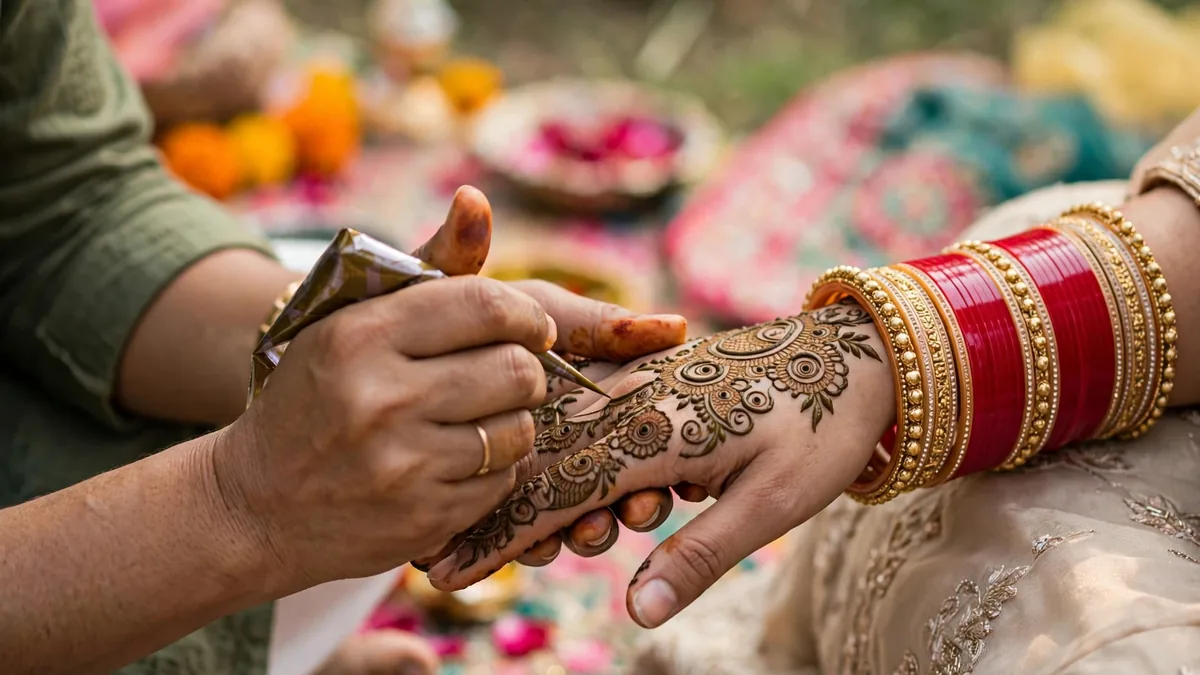
The mehndi is the henna night, usually one of the first big events. The bride’s hands and feet are covered in intricate henna designs by a professional henna artist while family and friends dance, eat, and celebrate around her. Colors run bright, think marigolds, yellow and green outfits, and festive folk music. In many families the bride sits on a decorated swing while guests get small henna designs of their own from a second artist. A mehndi typically runs 3 to 5 hours in the evening, often at home or in a rented hall, and it is the most relaxed event of the wedding week. For a full breakdown of what happens, how to book a henna artist in the US, what it costs, and how the day flows, read our mehndi ceremony planning guide.
Sangeet
The sangeet is the music night, and it is the party of the wedding week. Families prepare choreographed dance performances, there is often a friendly competition between the bride’s side and the groom’s side, and a DJ or live dhol player keeps the energy high late into the night. Sangeets usually have a stage, a sound system, and a dinner, making it one of the pricier pre-wedding events. Rehearsals typically start 4 to 8 weeks before the wedding, and in US families it is common for cousins flying in from different states to learn choreography over video calls. A detailed sangeet planning guide is one of our coming guides and will cover program flow, performance planning, and sound and venue logistics.

Baraat
The baraat is the groom’s procession to the ceremony venue, and it is pure joy. The groom arrives on a horse or in a decorated car while his family and friends dance around him to the beat of a dhol, often blocking traffic and drawing a delighted crowd. In the US, the baraat usually happens in the venue’s parking lot or a nearby street with a permit, and many venues in desi-heavy cities are used to it. Plan 30 to 60 minutes for the procession itself, plus buffer time, because a good baraat never ends on schedule. A baraat planning guide is also among our coming guides, covering horse vendors, dhol players, permits, and timing.

Nikkah and Shaadi: The Ceremony Itself

Walima and Reception
The walima is the groom’s family’s reception dinner in Muslim tradition, usually held a day or two after the nikkah or shaadi. It is often the most formal event, with speeches, a grand entrance, and the biggest guest list. In Hindu families and in many mixed US weddings, the equivalent is simply the reception, sometimes combined with the walima concept into one grand final night. Either way, this is the event with the fullest catering, the biggest decor, and the family portraits. A walima planning guide is in our coming guides.
Classic Multi-Day Desi Wedding Structures
There is no single correct structure, but most US desi weddings follow one of three templates. Pick the one that fits your guest count, budget, and how many out-of-town relatives are flying in.
The Classic 3-Day Weekend
This is the most common format for US desi weddings, and it keeps travel manageable for guests.
| Day | Event | Typical timing | Guest count |
|---|---|---|---|
| Friday evening | Mehndi | 5 PM to 10 PM | 80 to 150, mostly family |
| Saturday evening | Sangeet | 6 PM to 11 PM | 150 to 250 |
| Sunday | Baraat, nikkah or shaadi, walima or reception | Baraat 10 AM, ceremony 11 AM to 1 PM, reception 6 PM to 11 PM | 250 to 400 |
Sunday is a long day, so build in a real rest break between the ceremony and the reception. Many couples use the gap for couple portraits at golden hour, which also gives out-of-town guests time to rest and change.
The Extended 4 to 5-Day Celebration
Families with deep roots in the tradition, or with many relatives visiting from South Asia, often stretch the celebration. Day 1 might be a welcome dinner or dholki (an intimate night of traditional songs at home), Day 2 the mehndi, Day 3 the sangeet, Day 4 the ceremony, and Day 5 the walima or reception, sometimes with a farewell brunch. This structure costs more in venues and catering but gives each event room to breathe. If you go this route, consider booking one hotel as a home base and negotiating a room block early.
The Condensed 2-Day Version
Busy professionals and smaller families increasingly compress everything. Day 1 combines the mehndi and sangeet into one evening (mehndi first, performances after dinner), and Day 2 carries the baraat, ceremony, and reception. You lose some of the relaxed sprawl, but you save a full venue rental and a catering day, which can cut $10,000 to $20,000 from the budget.
How Much Does a Desi Wedding Cost in the US?
A desi wedding in the US is a multi-event production, so the honest answer is a range, not a number. For 2026, industry planning estimates put most multi-event desi weddings between $60,000 and $150,000. Large celebrations with 200 to 300 guests typically run $100,000 to $250,000, and intimate weddings of 50 to 100 guests can land between $30,000 and $80,000. Luxury productions pass $250,000. The range our site uses as a headline, $50K to $200K+, reflects the same reality: the guest list and the number of catered events drive everything.
The key budgeting insight is to count catered guest-meals across all events, not just the biggest guest count. A 200-person reception plus a 150-person sangeet plus a 60-person mehndi is 410 catered meals, not 200 guests. At typical full-service desi catering rates of $85 to $150 per person per event in the US (cheaper in Houston and Dallas, pricier in New York and New Jersey), food alone can be 40 percent of the budget.
| Event | Typical US cost range | Biggest cost drivers |
|---|---|---|
| Mehndi (80 to 150 guests) | $3,000 to $10,000 | Venue, catering, henna artist ($350 to $800 for bridal) |
| Sangeet (150 to 250 guests) | $8,000 to $25,000 | Venue, dinner catering, DJ and sound ($1,500 to $7,000), stage and lighting |
| Baraat + ceremony (250 to 400 guests) | $15,000 to $45,000 | Venue, mandap and decor ($4,000 to $10,000+), catering |
| Walima or reception (250 to 400 guests) | $20,000 to $60,000 | Venue, full dinner, decor, entertainment |
| Multi-day photo and video | $5,000 to $20,000 | Days covered, team size, albums |
| Bridal outfits (multiple events) | $2,000 to $10,000+ | Designer pieces, custom work, fittings |
| Wedding planner or coordinator | $3,500 to $35,000 | Full planning vs day-of coordination |
For the full US budget framework, percentages per category, and what different totals actually buy, read our wedding budget breakdown. The biggest savings lever in a desi wedding is always the same: fewer catered meals. Trimming 100 reception guests at $110 a plate saves $11,000 in one line item.
US Planning Basics: Vendors, Venues, and Timelines
Desi weddings have a vendor list that looks different from a standard American wedding. Here is who to book and when.
The vendors you actually need
Beyond the usual photographer, caterer, and florist, a US desi wedding typically needs a henna artist (book 3 to 6 months out; top bridal artists in big metros book out a year ahead), a decor company that does mandaps, stages, and draping (many specialize only in South Asian weddings), a DJ who understands desi music plus often a separate dhol player, a makeup artist experienced with South Asian skin tones and bridal looks (trials are essential), and an officiant for the religious ceremony. Photographers should be asked specifically about multi-day coverage packages, since a one-day quote does not cover a three-day wedding.
Venues that work for desi weddings

A realistic 12-month planning timeline
| When | What to do |
|---|---|
| 12 to 10 months out | Set the budget, draft the guest list, lock the date and hold the main venue |
| 10 to 8 months out | Book photographer, makeup artist, decor company, and caterer; these vendors vanish first |
| 8 to 6 months out | Commission bridal outfits (custom work takes 3 to 4 months); start the groom’s outfits; begin sangeet dance planning |
| 6 to 4 months out | Book henna artist, dhol player, and DJ; send invitations; shop for family outfits |
| 4 to 2 months out | Makeup and hair trials, final menu tasting, outfit fittings, book hotel room block |
| Final month | Get the marriage license, confirm RSVPs per event, finalize the day-of timeline, and delegate everything |
Planning Tips for Mixed and Fusion Families
Some of the most beautiful US desi weddings blend two cultures, and they need a little extra diplomacy. First, decide the ceremony structure early: many couples do both ceremonies (for example, a nikkah and a Hindu ceremony, or a desi ceremony plus a short Western exchange of vows) either back to back or on separate days. Second, translate everything for the side that is new to it. A printed program that explains each ritual in two or three lines turns confused guests into engaged ones. Third, talk about money and expectations with both families separately before any joint planning meeting, because assumptions about who pays and who decides differ enormously between cultures. Fourth, let each family own one event. If her family runs the mehndi and his family runs the sangeet, both sides feel represented instead of managed. Our coming fusion wedding guide will cover ceremony orders, program wording, and family diplomacy in depth.
What Desi Wedding Guests Should Know
Invited to your first desi wedding? A few norms will make you comfortable. Dress: colorful formal wear is welcome and expected. Women often wear lehengas or sarees; men wear kurtas or suits. Avoid white and black at Hindu ceremonies, where white is associated with mourning. Many mosques and some ceremonies require covering your head, so bring a scarf. Gifts: money in an envelope is standard, and amounts traditionally end in 1 (like $101 or $251), because odd numbers are considered auspicious. Events: your invitation may list several events, and not everyone is invited to everything. An invitation to the sangeet does not automatically include the mehndi. Timing: desi weddings famously run late. A 7 PM start may mean 8 PM, and nobody panics about it. Food: expect a feast, often buffet-style with live stations. Vegetarian options are almost always abundant. Shoes: you will remove them before entering prayer spaces and sometimes the mandap area, so wear something easy to slip off.
Desi Wedding FAQs
How many days is a desi wedding?
Most US desi weddings run 2 to 3 days, with the classic structure being a mehndi night, a sangeet night, and the ceremony plus reception. Some families extend to 4 or 5 days; others compress everything into 2. Single-day desi weddings exist but are rare.
What is the difference between a desi wedding and an Indian wedding?
“Indian wedding” usually implies Hindu traditions specifically, while “desi wedding” is the broader term covering Pakistani, Indian, Bengali, and other South Asian weddings across Muslim, Hindu, Sikh, and Christian faiths. In the US, couples often say “desi wedding” when the celebration blends traditions.
Do you need a wedding planner for a desi wedding?
For a multi-day desi wedding, at minimum hire a day-of coordinator who has worked South Asian weddings. Full planners run $3,500 to $35,000 in the US, but even day-of coordination prevents the classic problem of the baraat, the photographer, and the caterer all operating on different schedules.
Can non-desi guests attend a desi wedding?
Absolutely, and they are warmly welcomed. Wear colorful formal clothes, bring a monetary gift in an envelope, expect to remove your shoes at religious spaces, and be ready for a long, joyful, very late night.
The Bottom Line
A desi wedding is a marathon disguised as a celebration: six distinct events, three days of outfits, hundreds of guests, and costs that reward careful per-event budgeting. Start with the structure that fits your family, count your catered meals honestly, book the specialist vendors early, and use this page as your hub. Our deep-dives on the nikkah and mehndi are live now, and our coming guides on the sangeet, baraat, walima, wedding timeline, and fusion weddings will link back here as they publish. Plan the events, respect the math, and enjoy every loud, colorful, delicious minute of it.