How to Prepare for Wedding Dress Shopping

Learning how to prepare for wedding dress shopping before your first appointment is the difference between a fun, confident day and an overwhelming one. Most brides walk into their first bridal boutique with a few saved photos and a vague idea of what they like. They walk out hours later having tried on a dozen gowns, heard a dozen new terms, and felt pressure to decide on the spot. A little preparation changes all of that. When you know your budget, your timeline, your venue, and the styles that suit you, every appointment becomes easier and every dress you try on teaches you something useful.
This guide walks you through how to prepare for wedding dress shopping step by step: when to start, how much to budget, what to research, how to book appointments, what to bring, who to bring, and what actually happens inside the fitting room. It also covers the parts most guides skip, like deposits, ordering contracts, alteration costs, and the mistakes that cost brides money and stress. By the end, you will have a clear plan and a checklist you can use before your very first appointment.
When to Start Wedding Dress Shopping

Start shopping 9 to 12 months before your wedding date. That sounds early, but wedding dresses are almost always made to order. Once you place your order, the designer needs 4 to 8 months to produce the gown, and alterations usually take another 6 to 8 weeks after the dress arrives. Starting a year out gives you time to visit a few boutiques, compare styles, and still leave room for fittings without paying rush fees.
If your wedding is less than 9 months away, do not panic. Many boutiques carry sample gowns you can buy off the rack, and several designers offer rush production for an extra fee, usually 15 to 30 percent of the dress price. Off-the-rack and rush options narrow your choices, but they work fine when time is short. The worst option is waiting until 3 months before the wedding and discovering that your dream designer needs 6 months to make the dress.
| Time before wedding | What to do |
|---|---|
| 12 to 18 months | Research styles, fabrics, and designers; save inspiration photos; set your budget |
| 9 to 12 months | Book boutique appointments; start trying on dresses |
| 8 to 9 months | Order your dress and pay the deposit |
| 3 to 4 months | Dress arrives; book your first alteration fitting |
| 6 to 8 weeks | Second fitting; order shoes and accessories if you have not yet |
| 2 to 3 weeks | Final fitting; pick up your dress and store it safely |
One more timing tip: confirm your wedding date and venue before you shop. Your consultant will ask about both in the first five minutes, because the venue and the season decide which fabrics and silhouettes make sense. A heavy satin ballgown is wonderful in a December ballroom and miserable at a July garden ceremony.
Set Your Wedding Dress Budget Before You Book Anything
The most common wedding dress shopping mistake is walking into a boutique without a firm budget. Consultants pull dresses based on the number you give them, and if you do not give one, they will show you gowns across the whole price range. Falling in love with a $4,500 dress when your budget is $1,500 only creates stress. Decide your number at home, before any appointment, and tell every boutique the same number.
Your dress budget is not just the price tag on the gown. Plan for the full cost of getting wedding-day ready. In the United States, the average wedding dress costs around $1,900 to $2,000, but the total attire bill is usually higher once alterations, accessories, and tax are added.
| Item | Typical US cost |
|---|---|
| Wedding dress | $1,000 to $3,000 (most boutiques); $500 and under at budget retailers |
| Alterations | $300 to $800, depending on the work needed |
| Veil | $100 to $400 |
| Shoes | $75 to $300 |
| Undergarments and shapewear | $50 to $150 |
| Jewelry and hair accessories | $50 to $300 |
| Sales tax | Varies by state, usually 0 to 10 percent |
A practical rule is to reserve 15 to 20 percent of your total attire budget for alterations and accessories. If your total budget is $2,000, shop for a dress around $1,500 to $1,600 and keep the rest for everything else. Also ask who is paying. If parents or family members are contributing, agree on the number with them before the first appointment so there are no awkward conversations in the boutique.
Know Your Venue and Wedding Style First
Your venue and your wedding style should shape your dress choice more than any photo online. A formal ballroom calls for a different gown than a beach ceremony or a backyard wedding. Before you shop, write down three things: your venue type, your wedding season, and the overall feel you want, such as classic, romantic, modern, bohemian, or glamorous.
Season matters more than most brides expect. Light fabrics like chiffon, organza, and crepe breathe well in summer and move beautifully outdoors. Heavier fabrics like satin, mikado, and layered tulle suit fall and winter weddings and hold their shape in a formal setting. Long sleeves and high necklines feel right in cooler months, while sleeveless and strapless styles suit warm weather.
Venue rules matter too. Some churches and religious venues require covered shoulders, some historic venues ban trains that drag across delicate floors, and some outdoor venues mean grass, gravel, or sand underfoot. Ask your venue about dress restrictions before you shop, not after you have ordered a gown that breaks a rule. If you are still comparing venues, our guide to wedding venue types can help you match the setting to the style.
Learn the Silhouettes, Necklines, and Fabrics

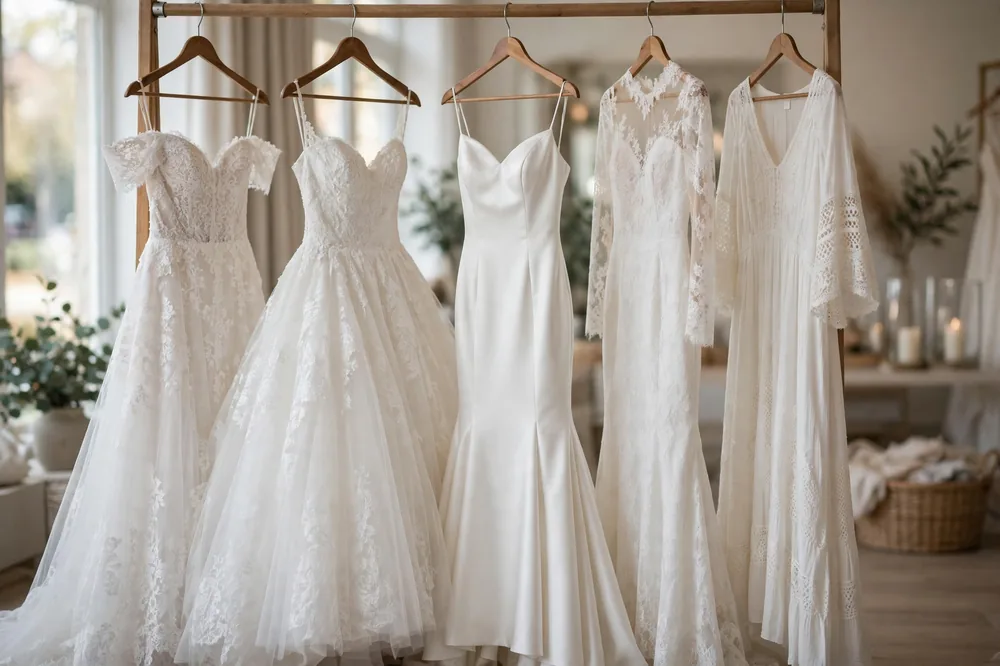
You do not need to become a bridal expert, but learning the basic vocabulary before your appointment helps enormously. It lets you describe what you like, understand what your consultant suggests, and skip styles that will never work for you. Start with the six main silhouettes.
| Silhouette | What it looks like | Best for |
|---|---|---|
| A-line | Fitted bodice, skirt flares gently from the waist | Almost every body type; the safest first try |
| Ballgown | Fitted bodice, very full skirt | Formal weddings, brides who want drama |
| Mermaid | Fitted through the bodice, hips, and thighs, flares at the knee | Brides who want a fitted, statement look |
| Sheath | Straight, narrow shape from shoulders to hem | Beach and casual weddings, minimalist style |
| Fit-and-flare | Fitted bodice, gentle flare below the hips | A middle ground between A-line and mermaid |
| Empire waist | High waistline just below the bust, flowing skirt | Comfort, outdoor weddings, maternity-friendly |
Necklines change the whole feel of a dress. A sweetheart neckline is romantic and classic, a V-neck lengthens the torso, a strapless neckline shows off the shoulders, and a high neckline or illusion neckline feels modest and elegant. If you are drawn to lace, read our guide to lace wedding dresses to see how different lace styles and necklines work together.
Fabrics are the third piece. Satin is smooth and structured, chiffon is light and floaty, tulle is airy and layered, crepe is clean and modern, organza is crisp and sheer, and lace adds texture and romance. When you try dresses on, notice how each fabric moves when you walk and sit. A dress that looks perfect standing still can feel stiff or heavy after ten minutes, and you will wear it for ten hours.
Build Your Inspiration Folder and Keep an Open Mind
Before your first appointment, collect 10 to 15 photos of dresses you love. Save them on your phone or in a Pinterest board and look for patterns. Do you keep saving A-line dresses with lace? Do you always pick the same neckline? Those patterns tell your consultant where to start, and they save time in the boutique.
At the same time, keep an open mind. Ask any bridal consultant and they will tell you the same story: most brides end up choosing a dress nothing like the one in their saved photos. A silhouette you dismissed online can look completely different on your body, and a detail you never considered can become your favorite part of the dress. The smart approach is to try one or two dresses outside your comfort zone at every appointment. You can always say no, and you might be surprised.
Also think about dresses you have worn before. If you have always felt great in fit-and-flare shapes and uncomfortable in strapless tops, that is useful information. Your past experience with everyday dresses is a better guide than any trend list, because comfort is part of looking good.
How to Book Bridal Boutique Appointments
Most bridal boutiques in the US work by appointment only, and weekend slots fill up weeks ahead. Book your first appointments 2 to 3 weeks in advance, and plan for 60 to 90 minutes per boutique. Trying on dresses takes time, and rushing through appointments is how brides end up making pressured decisions.
Start with 2 to 3 boutiques, not 8. Research each one before you book: check their price range, their designers, and their reviews. A boutique that starts at $3,000 is a waste of your time if your budget is $1,200, and a boutique that stocks only modern minimalist gowns will frustrate you if you want a classic ballgown. Call or check the boutique website for their price range if it is not listed, and ask whether they carry sample sizes close to yours.
Book weekday appointments when you can. Boutiques are quieter on weekdays, consultants have more time, and you get more attention. Bring your inspiration photos on your phone, and tell the boutique your budget, your wedding date, and your venue when you book. That way the consultant can pull dresses before you arrive instead of starting from zero.
Who to Bring to Your Wedding Dress Appointment
Bring 1 to 3 people whose opinions you trust and who will be honest with you. The best entourage is small: your mom, your maid of honor, a sister, or a close friend. These are the people who know your style and will tell you the truth, kindly, when a dress is not right.
A large group sounds fun, but it usually makes shopping harder. Five or six opinions in a small fitting room create noise, not clarity, and conflicting reactions can shake your confidence in a dress you actually loved. Some boutiques also limit how many guests you can bring, so check the policy when you book.
Choose people who support your taste, not people who want to relive their own wedding through yours. If someone in your life is strongly opinionated about what a bride should wear, consider leaving them for a later appointment, after you have already found your dress. The appointment is about you, and you should be the one who says yes.
What to Bring to Your Wedding Dress Appointment
Packing the right things makes every dress look closer to how it will look on your wedding day. Bring these essentials to every appointment:
- Nude, seamless underwear: Wear underwear you are comfortable being seen in, because your consultant will help you change. Nude and seamless styles disappear under light fabrics like crepe and chiffon.
- A strapless bra or adhesive bra: Bring one if you own it. Some boutiques provide one, but your own fit is more reliable.
- Shoes with a similar heel height: Bring shoes close to the heel height you plan to wear on the wedding day. Hem length and posture change completely with heel height, and boutiques often have sample heels, but they rarely fit well.
- Hair ties and clips: Bring a clip or tie so you can see how a dress looks with your hair up and down.
- Minimal makeup, done the way you like it: Do your hair and makeup the way you imagine it on the wedding day. It helps you see the full picture instead of a dress on a bare face.
- Your inspiration photos: Keep them on your phone, ready to show your consultant.
- A water bottle and a snack: Appointments run long, and trying on heavy gowns is surprisingly tiring. Stay comfortable.
- A trusted opinion, not a camera crew: Ask the boutique about its photo policy. Many allow photos, but some do not, because designers restrict images of new collections.
Skip heavy body makeup on your neck and shoulders, since it can transfer onto sample gowns, and skip spray tan the day before an appointment for the same reason.
What Happens During the Appointment
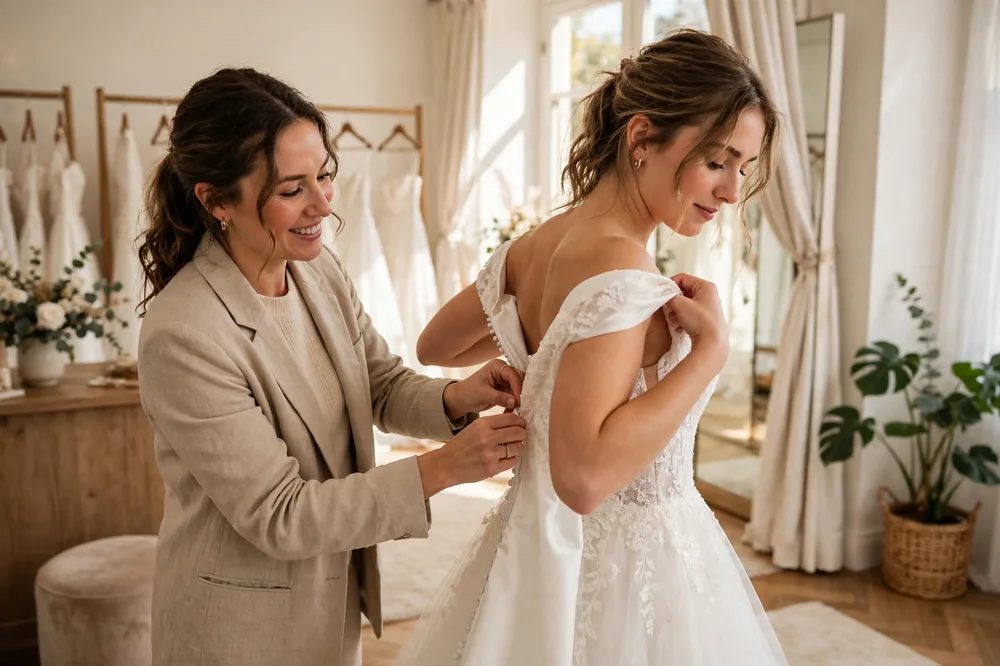
A typical bridal appointment lasts 60 to 90 minutes and follows a simple pattern. First, your consultant will sit with you for a few minutes and ask about your wedding date, venue, budget, and the styles you like. Show your inspiration photos here. Then the consultant pulls 5 to 8 dresses to start, and you try them on one at a time with the consultant’s help.
Sample gowns are usually one or two sizes, often a bridal size 10 or 12, and they are clipped at the back to approximate your shape. Do not judge a dress by how it fits off the rack. Judge it by the silhouette, the neckline, the fabric, and how it makes you feel. The ordered dress will be made in your measurements, so fit problems in the sample are normal and fixable.
Expect to try 5 to 10 dresses in one appointment. After each one, step out, look in the mirror, walk a little, sit down, and notice how it feels. Ask yourself three questions: Do I feel like myself? Can I move, sit, and dance in this? Do I keep thinking about it after I take it off? The dress you keep thinking about is usually the one.
Good consultants never pressure you to decide on the spot. If a boutique pushes you to buy today with a discount that expires when you leave, treat that as a red flag. A dress you love will still be there tomorrow, and a reputable boutique will hold it or let you come back.
Understanding Wedding Dress Sizing and Ordering
Bridal sizing surprises almost every bride, so hear this before your first appointment: wedding dress sizes run small. A bride who wears a size 6 in everyday clothes often orders a bridal size 10 or 12, and that is completely normal. Bridal sizing follows an older measurement standard, and the number on the tag means nothing about your body. Focus on the fit, not the number.
When you order, the boutique takes your bust, waist, and hip measurements and orders the size closest to your largest measurement. The dress is then altered down to fit. This is standard practice, and it is why alterations are part of nearly every wedding dress budget.
Ordering also means a deposit and a contract. Most boutiques require a deposit of 50 to 60 percent of the dress price when you order, with the balance due when the dress arrives. Before you sign, read the contract and ask these questions:
- What is the expected delivery date, and what happens if the dress arrives late?
- Is the deposit refundable if I change my mind?
- Are alterations done in-house or by an outside tailor, and what do they cost?
- Does the price include the veil, or is that separate?
- What is the rush fee if I need the dress faster?
- What happens if the dress arrives damaged or in the wrong size?
Get the answers in writing. A reputable boutique will answer all of these happily, and the contract protects both sides. If a boutique rushes you past the paperwork, slow down and read it anyway.
Alterations: What to Expect and What They Cost
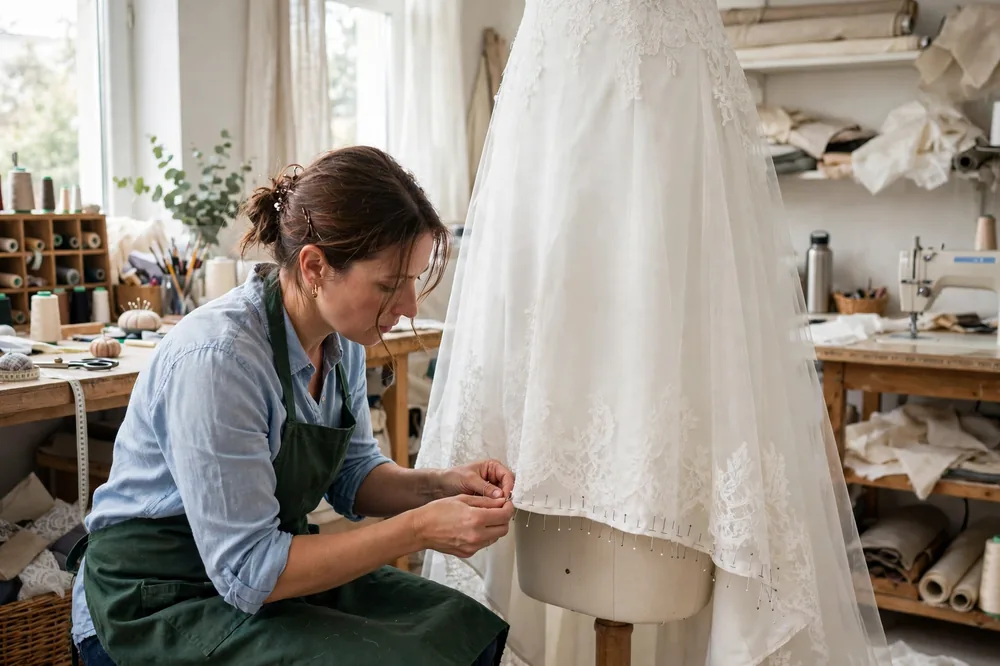
Almost every wedding dress needs alterations, even when it was ordered in your exact measurements. Samples are made to standard proportions, and real bodies are not standard. Plan for 2 to 3 fittings, starting about 8 to 12 weeks before the wedding, with the final fitting 2 to 3 weeks before the day.
Common alterations include taking in or letting out the bodice, hemming the skirt, adding a bustle so the train lifts for dancing, adjusting straps, and adding cups or support. A bustle is the system of buttons or ties that lifts the train off the floor after the ceremony, and it is one of the most useful alterations you can get.
Alteration costs in the US usually run $300 to $800. Simple hems and bodice adjustments sit at the low end, while restructuring a bodice, changing a neckline, or adding sleeves can push costs higher. Get an alteration estimate before you order the dress if you can, and bring your wedding shoes and undergarments to every fitting so the hem and fit are measured correctly.
Shopping Online and Try-at-Home Options
Not every bride shops in a boutique, and online options have improved a lot. Try-at-home services let you order sample dresses to try on at home, usually for a small fee per dress, and return them within a set window. This suits brides who live far from boutiques, prefer privacy, or want to try styles before committing to appointments.
Online shopping works best when you already know your silhouette and size. Order from retailers with clear return policies, read reviews about sizing and fabric quality, and check whether the price includes alterations or whether you will need a local tailor. Be careful with marketplace sellers offering designer gowns at a fraction of the price, since counterfeit dresses are common and the fabric and construction rarely match the photos.
A hybrid approach works well for many brides: try dresses on in a boutique to learn what suits you, then compare prices and options online before ordering. Just remember that boutiques earn their margin by providing the service, the samples, and the fitting expertise, so ordering the exact dress elsewhere after using a boutique’s time is a choice to make thoughtfully.
Common Wedding Dress Shopping Mistakes to Avoid
Most dress shopping regrets come from the same handful of mistakes. Here are the ones to watch for:
- Shopping too early: Buying a dress more than 18 months before the wedding risks changing your mind about style, and your body and tastes can change too. Start a year out, not two.
- Shopping without a budget: Trying on dresses above your budget sets you up for disappointment or overspending. Set the number first.
- Trying on too many dresses: After 15 or 20 gowns, they all blur together. Limit yourself to a few boutiques and trust your early favorites.
- Bringing too many opinions: A big group creates confusion. Keep the entourage small and honest.
- Ignoring comfort: A dress that pinches, itches, or restricts your breathing will ruin your day, no matter how beautiful it looks in photos. Move, sit, and walk in every contender.
- Forgetting the venue: A cathedral train does not belong on a beach, and a lightweight sheath can look underdressed in a grand ballroom. Match the dress to the setting.
- Buying under pressure: Never buy a dress because a consultant says the discount ends today or another bride is eyeing the sample. Sleep on it if you are unsure.
- Skipping the contract: Read the ordering terms, the deposit policy, and the delivery date before you sign anything.
How to Prepare for Wedding Dress Shopping: Your Final Checklist

Use this checklist in the week before your first appointment, and you will walk in ready.
- Wedding date and venue confirmed
- Total attire budget set, including alterations and accessories
- Inspiration folder with 10 to 15 saved photos
- Basic knowledge of silhouettes, necklines, and fabrics
- 2 to 3 boutiques researched and booked, with your budget shared in advance
- Entourage chosen: 1 to 3 trusted people
- Nude seamless underwear, strapless bra, and shoes with the right heel height packed
- Hair and makeup planned the way you want them on the day
- Questions ready about deposits, delivery dates, and alteration costs
- An open mind and a willingness to try one unexpected style
Wedding dress shopping should feel exciting, not stressful. With your budget set, your timeline clear, and your bag packed, the appointments become what they are meant to be: a chance to try on beautiful dresses and find the one that feels like you. Trust your instincts, take your time, and remember that the right dress is the one you cannot stop thinking about after you take it off. If you are still planning the bigger picture, our wedding dress patterns guide is a useful next read if you are considering a custom or handmade gown.
Frequently Asked Questions About How to Prepare for Wedding Dress Shopping
How far in advance should I start wedding dress shopping?
Start 9 to 12 months before your wedding. Designers need 4 to 8 months to make the dress, and alterations take another 6 to 8 weeks.
How many dresses should I try on?
Most brides try 5 to 10 dresses per appointment and visit 2 to 3 boutiques. After about 20 dresses total, choices start to blur, so keep the number manageable.
What should I wear to a wedding dress appointment?
Wear nude, seamless underwear and bring a strapless bra and shoes with a heel height close to what you will wear on the wedding day. Do your hair and makeup the way you imagine them for the wedding.
Do I need an appointment to try on wedding dresses?
Yes, most US bridal boutiques are appointment only. Book 2 to 3 weeks ahead, especially for weekend slots.
How much should I budget for wedding dress alterations?
Plan $300 to $800 for alterations in the US, and reserve 15 to 20 percent of your total attire budget for alterations and accessories together.