
How to Plan a Honeymoon on a Budget (2026 Guide)

A honeymoon does not need a five-figure budget to feel like a honeymoon. What it needs is a plan: a real number you both agree on, a destination that fits that number, and a booking strategy that squeezes luxury out of ordinary prices. This guide shows you how to plan a honeymoon on a budget in the US, with three complete budget blueprints ($1,500, $3,000, and $5,000), the twelve money moves that matter most, the best affordable destinations, and a booking timeline that keeps you ahead of price hikes.
Couples routinely overspend on honeymoons for one reason: they pick the destination first and the budget never. Flip the order. Decide the number, then find the trip that fits inside it. A $3,000 honeymoon planned around the number beats a $9,000 honeymoon planned around a Pinterest board, because the second one starts your marriage with credit card debt and the first one starts it with a great story.
Step 1: Decide the Number First
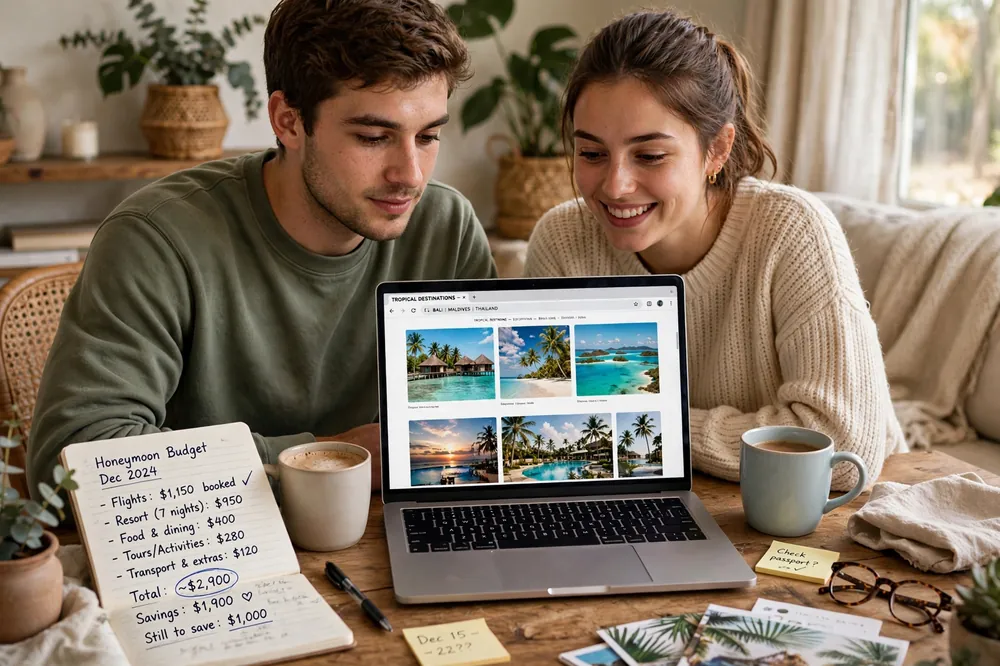
Sit down together and answer three questions. What is the absolute maximum we will spend? What would we like to spend? What is the one experience we refuse to give up? Write the answers down. Most American couples spend $4,000 to $6,000 on a honeymoon, but the right number is the one you can pay for without touching emergency savings or carrying a balance.
Then split the number into four buckets before you browse a single hotel: transport (flights, rental car, gas), lodging (usually 40 to 50 percent of the total), food and drink, and activities. Add a 10 percent buffer bucket for the things you will not predict. If any bucket cannot hold a realistic option, the destination is wrong for the budget, not the other way around.
One more decision to make early: are you leaving right after the wedding? A delayed honeymoon, even by a few weeks, unlocks shoulder-season prices and lets you actually enjoy the planning. There is no rule that says the honeymoon starts at the reception exit.
Three Budget Blueprints That Actually Work
Real numbers for real trips, built for two people. Adjust the line items to your departure city, but the structure holds anywhere in the US.
Blueprint 1: The $1,500 Great American Road Trip (5 days)
| Category | Plan | Cost |
|---|---|---|
| Transport | Drive a loop from home (600-900 miles round trip), one tank and a half | $140 |
| Lodging | 4 nights: mix of budget motels and one cabin/Airbnb splurge night | $480 |
| Food | Cooler breakfasts, one nice dinner out, casual local spots otherwise | $350 |
| Activities | National or state parks, free walking tours, one paid experience | $150 |
| Splurge | One romantic dinner at the best restaurant in town | $180 |
| Buffer | 10 percent for surprises | $150 |
| Total | $1,450 |

The road trip is the most underrated honeymoon in America. Blue Ridge Parkway in fall, the Pacific Coast Highway in spring, the desert Southwest in winter: the drive is the experience, and the memories-per-dollar ratio is unbeatable. Pack a cooler, download offline maps, and ban the phrase “we should have flown somewhere.”
Blueprint 2: The $3,000 Shoulder-Season Escape (7 days)
| Category | Plan | Cost |
|---|---|---|
| Flights | Two round trips booked 3+ months out, flying Tuesday/Wednesday | $700 |
| Lodging | 6 nights in a well-reviewed Airbnb or boutique hotel, shoulder season | $1,100 |
| Food | Kitchen breakfasts, market lunches, dinners out every other night | $600 |
| Activities | Mix of free exploring + two paid experiences (sunset sail, guided tour) | $300 |
| Buffer | 10 percent | $300 |
| Total | $3,000 |
This is the sweet spot for most couples. Shoulder season (late April to early June, or September to early November, depending on destination) cuts lodging 25 to 40 percent versus peak, with better weather than you would expect. Destinations that shine here: Charleston and Savannah, the Florida Keys, San Diego, and Puerto Rico.
Blueprint 3: The $5,000 “Feels Like $10,000” Trip (7 days)
| Category | Plan | Cost |
|---|---|---|
| Flights | Two round trips, booked with points covering one ticket | $450 |
| Lodging | 4 nights mid-range + 2 nights genuine luxury (the “two-speed” trick) | $2,200 |
| Food | One blowout tasting menu, otherwise smart casual | $800 |
| Activities | One signature experience (private boat, helicopter tour, spa day) | $600 |
| Transport | Rental car or transfers | $350 |
| Buffer | 10 percent | $500 |
| Total | $4,900 |
The secret is contrast, not constant luxury. Five comfortable nights plus two spectacular ones feels more luxurious than seven uniformly nice nights, because the splurge nights stand out in memory. Book the luxury nights at the end so the trip finishes on a high.
12 Ways to Cut Costs Without Feeling Cheap
Timing tricks
1. Travel shoulder season. This is the single biggest lever. The same hotel room that costs $400 a night in July costs $220 in late September. Shoulder season varies by destination, so look it up for yours specifically: for the Caribbean it is late spring and fall, for national parks it is May and September, for New England it is right after leaf-peeping ends.
2. Fly midweek. Tuesday and Wednesday departures are consistently the cheapest days to fly in the US, often $80 to $150 less per ticket than Friday or Sunday. If you can shift the whole trip by two days, do it.
3. Delay the departure. Leaving two to four weeks after the wedding instead of the next morning opens up cheaper dates, lets you use wedding gift money toward the trip, and means you plan the honeymoon when you are rested instead of exhausted.
Lodging tricks
4. Book a place with a kitchen. An Airbnb or extended-stay suite with a kitchenette lets you do breakfasts and some lunches in, which easily saves $50 to $80 a day for two people. Spend the savings on dinners worth remembering.
5. Stay slightly outside the famous neighborhood. One metro stop or a ten-minute drive from the postcard zone often cuts lodging 30 percent with zero loss of experience. Check that transit or parking is easy first.
6. Ask for the honeymoon upgrade. Mention you are honeymooners when booking and again at check-in. Hotels upgrade newlyweds constantly: better rooms, late checkout, a bottle of something. It costs nothing to ask, and it works far more often than people expect.
Food and drink tricks
7. Eat one great meal a day, not three. A spectacular dinner plus casual breakfasts and market lunches beats three mediocre restaurant meals on both memory and money. In most US cities, lunch at a great restaurant costs half the dinner price for the same kitchen.

8. Build your own minibar. Hotel minibars and resort drink prices are where budgets go to die. A $25 grocery run for drinks and snacks on arrival saves hundreds over a week. This alone can fund your splurge dinner.
Transport and booking tricks
9. Use points for the most expensive leg. If either of you has a travel credit card, the sign-up bonus alone often covers one international or two domestic tickets. Even without a new card, airline miles and hotel points from everyday spending add up fast if you start collecting at engagement, not at booking. Never open a card just for the honeymoon unless you will pay it off in full.
10. Compare packages against DIY. All-inclusive resorts in Mexico and the Caribbean and US cruise lines bundle food, drink, and entertainment into one predictable number. Price the package against booking separately, but remember the package’s real value: no surprise spending. For couples who hate tracking every dollar on vacation, that certainty is worth a small premium.
11. Set a daily spend limit. Divide the food-plus-activities budget by the number of days and track it loosely in your phone’s notes app. Couples who set a daily number almost always come home under budget. Couples who “just see how it goes” almost never do.
12. Prioritize one splurge, cut everything else. Agree on the single experience you will remember in ten years: the sunset sail, the spa day, the tasting menu. Spend freely on that one thing and be ruthless everywhere else. A honeymoon with one perfect memory beats a honeymoon with twelve forgettable ones.
Best Budget Honeymoon Destinations in the USA

You do not need a passport for a great budget honeymoon. These US destinations deliver romance at prices that keep the blueprints above realistic.
Florida Keys, Florida. Fly into Miami, drive the Overseas Highway (the drive is half the fun), and base in Key Largo or Islamorada instead of pricey Key West. Shoulder-season rates, sunset sails, and snorkeling run far cheaper than the Caribbean with a similar feel.
Charleston and Savannah. Two of the most romantic cities in America, both walkable, both packed with free beauty: historic streets, waterfront parks, and beach day-trips. Boutique inns in shoulder season run $150 to $220 a night.
Puerto Rico. No passport needed, Caribbean beaches, Old San Juan charm, and the only bioluminescent bays in US territory. Off-season deals from East Coast cities are consistently among the cheapest tropical fares in the country.
National parks road trip. Zion, Bryce, the Grand Canyon, or the Utah Mighty Five loop: park passes are $80 for the year, the scenery is unmatched, and gateway-town motels and cabins keep lodging cheap. Best in May or September.
Hawaiian island on points. Hawaii is expensive in cash but one of the best points redemptions in domestic travel. One ticket on miles plus a condo rental with a kitchen puts Oahu or the Big Island inside a $3,000 to $4,000 budget.
Asheville and the Blue Ridge, North Carolina. Mountain cabins with hot tubs, the Biltmore Estate, craft breweries, and fall foliage that rivals New England at half the lodging cost. A cabin for the week often costs less than three hotel nights elsewhere.
Booking Timeline: When to Lock In What
9 to 12 months out: pick the destination and the budget number. Start collecting points if you plan to use them. Set up fare alerts on Google Flights for your likely routes.
6 to 9 months out: book flights. For domestic US trips, the cheapest booking window is typically 1 to 4 months ahead, but honeymooners booking around a fixed wedding date should lock in earlier for peace of mind. Book refundable or flexible fares when the price difference is small.
4 to 6 months out: book lodging. Shoulder-season properties fill slower, but the best-reviewed Airbnbs and boutique hotels still go first. This is also when to book the one splurge experience.
2 to 3 months out: plan the day-to-day loosely. Reserve the must-do restaurants and activities. Buy travel insurance now, not later: a basic policy runs 4 to 8 percent of trip cost and covers the nightmare scenarios.
2 weeks out: confirm everything, download offline maps, notify your bank of travel, and pack. If you built a wedding day emergency kit for the wedding itself, pack a mini version for the trip: pain relievers, bandages, and stain remover earn their space twice.
Let Guests Fund It: The Honeymoon Registry
A honeymoon fund lets guests contribute to experiences instead of buying you a third toaster. Most wedding websites (Zola, Honeyfund, Blueprint) let you list specific gifts: “$80: sunset sail for two,” “$120: couples massage,” “$200: one night at the beach resort.” Guests love funding experiences, and specific listings get funded far more than a generic cash fund.
Two etiquette notes. First, a honeymoon registry works best alongside a small traditional registry, not instead of one; some guests, especially older relatives, want to give a physical gift. Second, mention it once on the wedding website and never in the invitation itself. Word spreads on its own. If you are still planning the celebration around it, our engagement party planning guide covers how registries and gift expectations work from the very start.
Frequently Asked Questions
How much should we budget for a honeymoon in the US? Most American couples spend $4,000 to $6,000, but excellent honeymoons run from $1,500 (road trip) to $3,000 (shoulder-season escape). Pick the number first, then the destination, and add a 10 percent buffer.
When is the cheapest time to honeymoon? Shoulder season for your specific destination, flying Tuesday or Wednesday. For tropical US destinations that means late spring and fall; for cities, January through March excluding holidays. Avoid the week after Christmas and spring break at all costs.
Are all-inclusive resorts actually cheaper? They are more predictable, which is different from cheaper. A $3,500 all-inclusive week for two in Mexico or the Caribbean often beats a DIY trip once you add up every meal, drink, and excursion honestly. Price both ways with real numbers before deciding.
Should we get travel insurance for our honeymoon? Yes, for any trip over $2,000 or involving flights. A basic policy costs 4 to 8 percent of the trip and covers cancellations, medical emergencies, and lost luggage. Buy it within two weeks of your first booking for the best cancel-for-any-reason options.
How do we keep the wedding itself from eating the honeymoon budget? Set the honeymoon number when you set the wedding budget, not after. Treat it as a non-negotiable line item, the same as the venue. Our wedding budget breakdown shows where the honeymoon fits and which wedding line items are safe to trim when the total needs to come down.